Epoxy grout coverage: how many sq.ft does 1 kg cover? (Chart by tile size)
The same 1 kg epoxy kit grouts about 100 sq.ft of 600 × 600 mm tiles or under 20 sq.ft of mosaic. The coverage chart by tile size and joint width, the formula behind it, and how many kits to buy.

ON THIS PAGE
- Mixed density
- 1.75 kg/L
- 600×600 @ 2 mm
- ≈ 100 sq.ft / kg
- 300×300 @ 3 mm
- ≈ 44 sq.ft / kg
- Mosaic 100×100
- ≈ 17–26 sq.ft / kg
- Kits
- 1 kg · 5 kg
- Joint width
- Up to 10 mm
KEY TAKEAWAYS
- 1 kg of Sumoxy epoxy grout covers about 100 sq.ft of 600 × 600 mm tiles at 2 mm joints, about 44 sq.ft of 300 × 300 mm at 3 mm, and under 30 sq.ft of mosaic.
- Coverage depends on joint length per sq.ft (tile size), joint width and joint depth — not on the brand.
- Formula: kg/m² = ((A + B) ÷ (A × B)) × joint width × depth × 1.75, then add 10% wastage.
- Mix only what you can use in the 45–60 min pot life; 1 kg kits suit small areas.
"How much area does 1 kg of epoxy grout cover?" has no single answer, and any shop that quotes one number is guessing. The same 1 kg kit can grout about 100 sq.ft of 600 × 600 mm floor tiles or under 20 sq.ft of mosaic. What changes is not the grout — it is how much joint there is in each square foot.
This guide gives you the coverage chart for common tile sizes, the formula behind it, and how to work out the number of 1 kg and 5 kg kits to buy.
The quick answer
For SUMO Sumoxy epoxy grout, 1 kg covers about:
- 100 sq.ft of 600 × 600 mm vitrified tiles with 2 mm joints;
- 44 sq.ft of 300 × 300 mm ceramic tiles with 3 mm joints;
- 17–26 sq.ft of 100 × 100 mm mosaic, depending on the joint width.
Bigger tiles mean fewer joints per square foot, so the same kilo goes further. Wider and deeper joints mean more grout in each joint, so it goes less far.
Epoxy grout coverage chart
Coverage of SUMO Sumoxy epoxy grout (density 1.75 kg/L) by tile size and joint width. Joint depth is taken as the tile thickness shown. Add 10% for wastage.
Tile size (thickness) | 2 mm joint | 3 mm joint | 5 mm joint |
|---|---|---|---|
100 × 100 mm mosaic (6 mm) | 26 sq.ft per kg | 17 sq.ft per kg | 10 sq.ft per kg |
300 × 300 mm ceramic (7 mm) | 66 sq.ft per kg | 44 sq.ft per kg | 26 sq.ft per kg |
300 × 600 mm (8 mm) | 77 sq.ft per kg | 51 sq.ft per kg | 31 sq.ft per kg |
600 × 600 mm vitrified (9 mm) | 103 sq.ft per kg | 68 sq.ft per kg | 41 sq.ft per kg |
800 × 800 mm vitrified (10 mm) | 123 sq.ft per kg | 82 sq.ft per kg | 49 sq.ft per kg |
600 × 1200 mm vitrified (9 mm) | 137 sq.ft per kg | 91 sq.ft per kg | 55 sq.ft per kg |
A 5 kg kit covers five times these figures — for example about 510 sq.ft of 600 × 600 mm tiles at 2 mm joints, or about 220 sq.ft of 300 × 300 mm tiles at 3 mm.
The formula behind the chart
Grout fills the joints, so the quantity is simply the volume of joint in one square metre multiplied by the density of the grout:
Grout (kg per m²) = ((A + B) ÷ (A × B)) × J × D × 1.75
- A and B are the tile length and width in mm;
- J is the joint width in mm;
- D is the joint depth in mm — normally the tile thickness;
- 1.75 is the density of mixed Sumoxy epoxy in kg per litre.
For a 600 × 600 mm tile, 9 mm thick, with 2 mm joints: (1200 ÷ 360,000) × 2 × 9 × 1.75 = about 0.105 kg per m². One kilo therefore covers about 9.5 m², or roughly 100 sq.ft.
You do not have to do this by hand: the tile grout calculator applies the same formula to your tile size, joint width, thickness and area and gives you the kits to buy.
How many kits to buy
- Measure the area to grout in sq.ft or m².
- Find your tile size and joint width in the chart, or use the calculator.
- Divide the area by the coverage per kg, then add 10% for wastage.
- Round up to whole kits.
Example: a 120 sq.ft bathroom floor in 300 × 300 mm tiles with 3 mm joints needs 120 ÷ 44 ≈ 2.7 kg, plus 10% ≈ 3 kg. Three 1 kg kits do the job.
Choosing 1 kg or 5 kg kits. Epoxy has a working time of roughly 45–60 minutes once the parts are mixed, and a mixed kit cannot be saved for tomorrow. Mix only what you can place and clean within the pot life. On small areas, or when one person is grouting, several 1 kg kits are usually better value than one 5 kg kit that partly sets in the bucket.
What changes the real consumption
- Joint depth. Joints that are not raked clean of adhesive are shallower and take less grout; joints on thick tiles or stone take more. Clean joints matter more for the bond than for the quantity — grout needs depth to hold.
- Joint width. Going from 2 mm to 3 mm uses 50% more grout; 2 mm to 4 mm doubles it.
- Uneven joints and lippage. Wavy joints and uneven tile edges hold extra grout.
- Cleaning losses. Some grout is always removed from the tile face. Working diagonally with a hard rubber float and cleaning promptly keeps it low — see the 30-minute window for grout haze.
2-part, 3-part and Sparkle
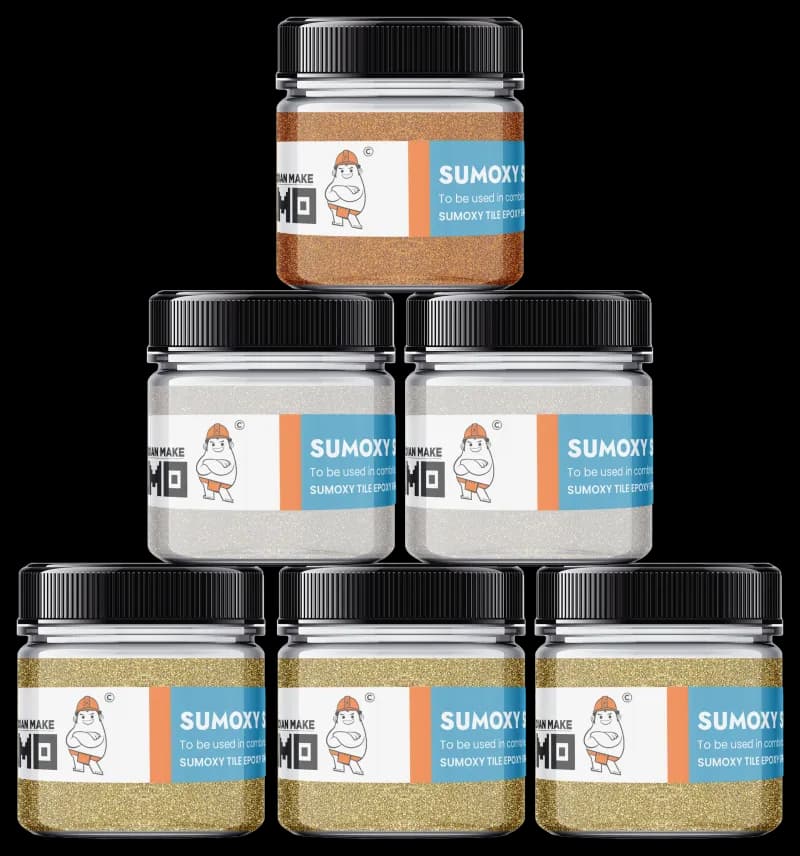
Sumoxy 2 Part and Sumoxy 3 Part have the same mixed density, so the coverage chart applies to both. Both suit joints up to 10 mm in ceramic, porcelain, vitrified tiles, natural stone and glass mosaic, and come in 1 kg and 5 kg kits. Sumoxy Sparkle is a metallic additive for a decorative finish — it changes the look, not the quantity of grout you need.
For cement grout instead of epoxy, the same joints take about 9% less by weight. If you are still deciding between the two, read epoxy grout vs cement grout.
The short version
- 1 kg of Sumoxy covers about 100 sq.ft of 600 × 600 mm tiles at 2 mm joints, about 44 sq.ft of 300 × 300 mm at 3 mm, and under 30 sq.ft of mosaic.
- Smaller tiles and wider, deeper joints use more grout.
- Use the formula or the grout calculator, add 10%, and round up to whole kits.
- Buy 1 kg kits for small areas so nothing sets in the bucket.