Stone fixing adhesive: how to fix granite, marble and Kota stone so it stays put
Granite, marble, Kota and sandstone each fail in their own way when the wrong bed goes behind them. Which C2 adhesive grade to use for each stone and location, how to get full contact, and where adhesive alone is not enough.

ON THIS PAGE
- Minimum grade for stone
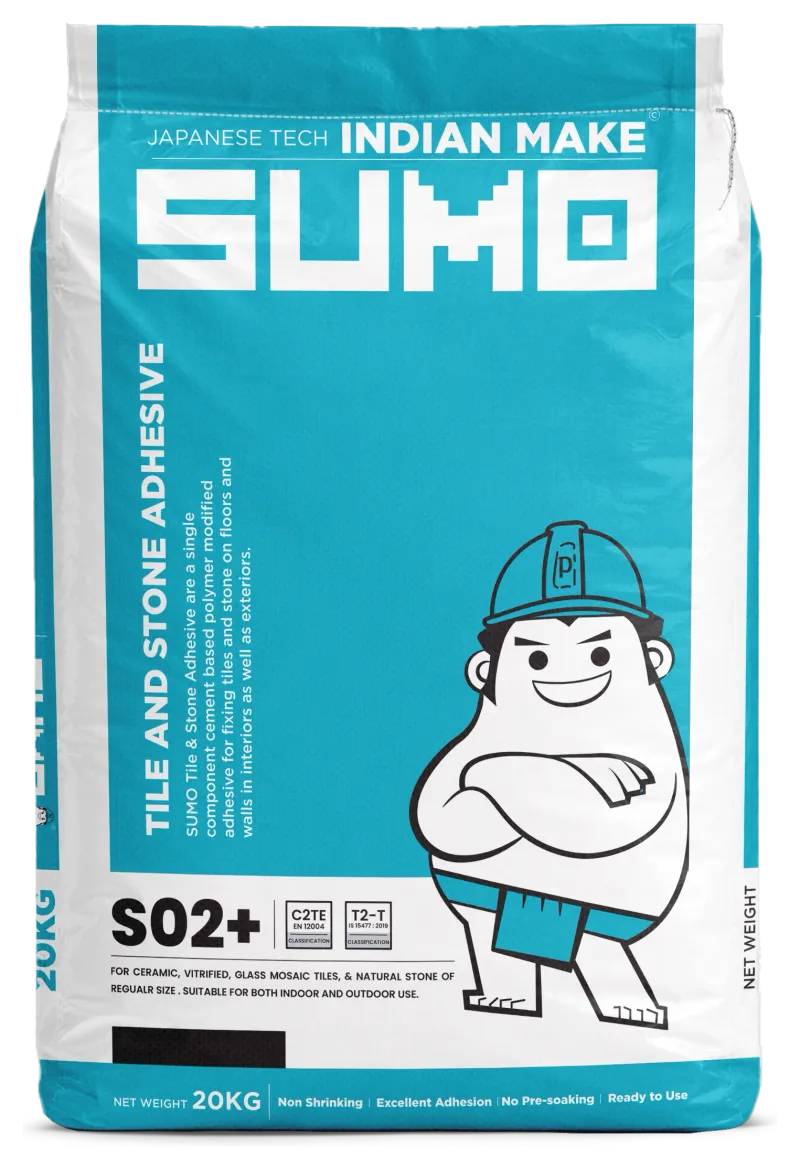
- C2TE (S02 Plus)
- Tensile adhesion (28 d)
- > 1.5 N/mm²
- Open time
- ~30 min
- Shades
- Grey · White
- Typical stone notch
- 10–12 mm + back-butter
- 20 kg bag @ 10–12 mm
- ≈ 26–32 sq.ft
KEY TAKEAWAYS
- Natural stone is heavy, uneven and moves with heat and moisture — it needs a C2, slip-resistant (T), polymer-modified adhesive, not cement slurry or "stone glue".
- S02 Plus (C2TE) for most indoor and outdoor stone; S03 (C2TE) for large slabs, wet areas and around frames; S04 (C2TES1) for pools and heavy-traffic floors.
- Use the white shade behind marble, pale granite and translucent stone so the bed does not shadow through.
- Comb with a 10–12 mm notch, back-butter every piece and aim for 95% contact; external cladding above head height also needs mechanical anchors.
Natural stone is heavy, it is rarely perfectly flat, and every type behaves differently once it is wet. That is why a stone floor or a granite cladding job that looks perfect on handover can sound hollow by the second monsoon, and why "stone fixing glue" from the hardware counter is the wrong answer for anything bigger than a broken corner.
Fixing stone well comes down to three decisions: the right adhesive grade for the stone and the location, enough adhesive behind every piece, and knowing where adhesive alone is not enough. This guide walks through all three for the stones most Indian sites actually use — granite, marble, Kota and sandstone.
Why stone needs a better adhesive than tile
A ceramic wall tile weighs a few kilos and is the same thickness edge to edge. A natural stone slab is a different load:
- It is heavy. An 18–20 mm granite slab weighs several times more than a vitrified tile of the same size. On a wall, that weight is trying to slide the slab down before the bed sets.
- It is uneven. Hand-dressed Kota, sandstone and uncalibrated granite vary in thickness across a single piece, so the adhesive has to fill a varying gap and still bond everywhere.
- It moves. Stone floors and façades heat up in the sun and cool at night, and the bed underneath has to follow that movement without letting go.
- Some stones are thirsty, some are sensitive. Sandstone and Kota soak up water; white marble shows any stain from behind; a few stones react badly to water-based setting materials.
Plain sand-cement can hold a porous stone on a floor, but it shrinks, it stains pale stone, and it cannot hold a heavy slab on a wall while it sets. A polymer-modified, slip-resistant C2 adhesive is what solves all four problems at once.
Which SUMO adhesive for which stone job
Every SUMO stone-grade adhesive is a C2 (high bond) adhesive with the T (slip-resistant) and E (extended open time) classes, and comes in both grey and white. The white shade matters: use it behind marble, pale granite and any light or translucent stone so the bed does not shadow through.
Job | Adhesive | Why |
|---|---|---|
Marble or granite floors and walls, indoors | S02 Plus (C2TE), white for marble | Built for heavy natural stone; ~30 min open time; tensile adhesion >1.5 N/mm² |
Exterior stone — balconies, terraces, façades, parapets | S02 Plus or S03 (C2TE) | Exterior grade; S03 is tested to stay above 1.0 N/mm² after water immersion, heat ageing and freeze–thaw |
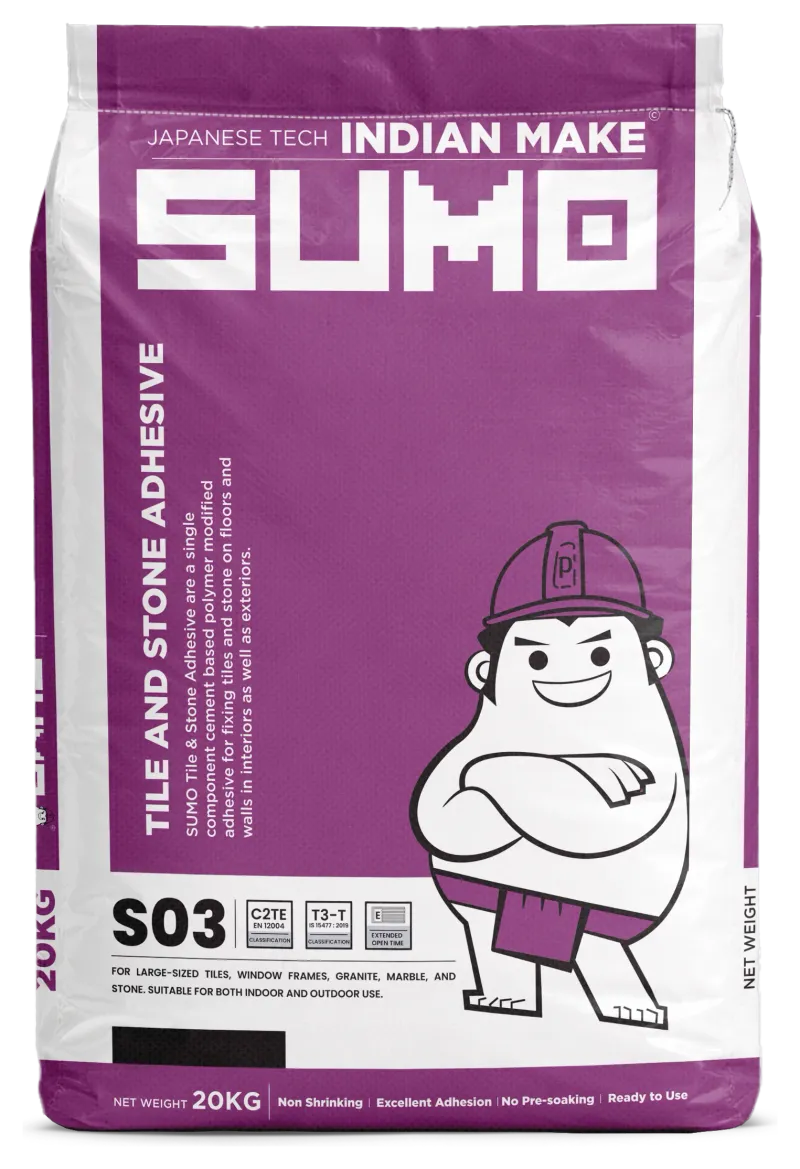
Large stone slabs, wet areas, stone around window and door frames | S03 (C2TE) | Highly polymer-modified for large formats and wet, moving areas |
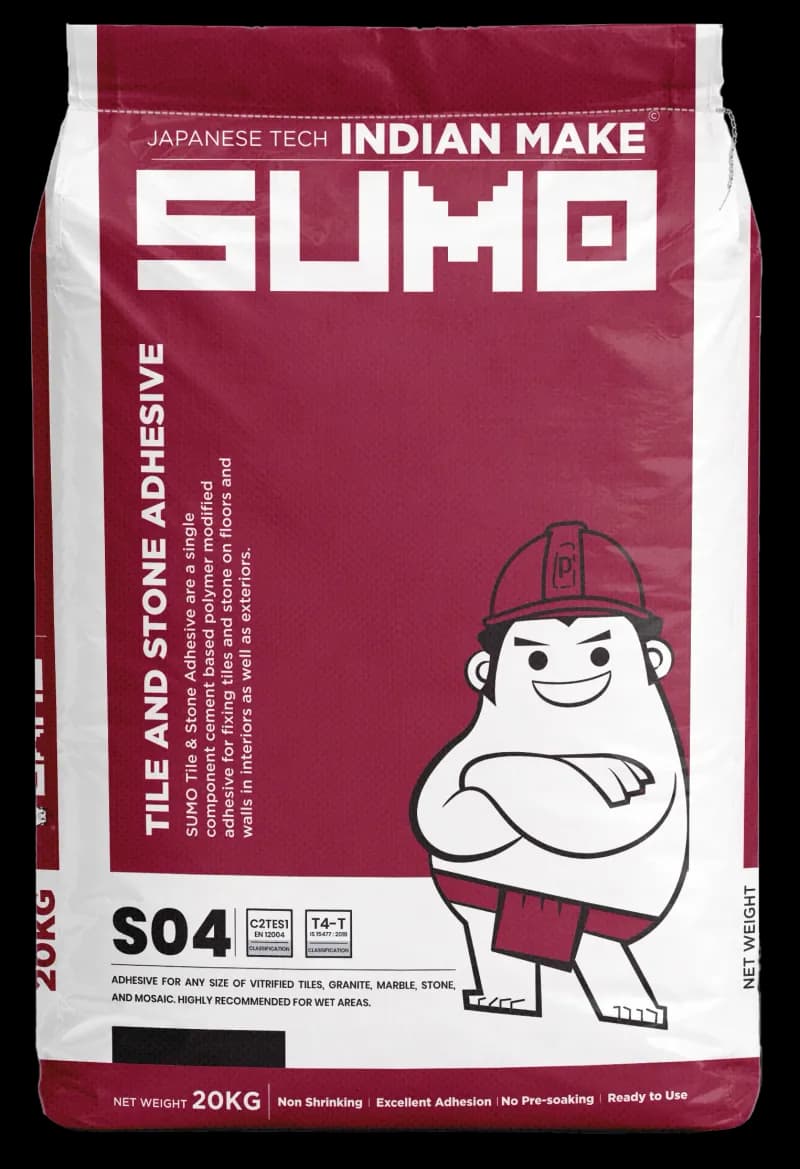
Swimming pools, continuously wet stone, heavy commercial floors | S04 (C2TES1) | Deformable S1 bond (2.5–5 mm transverse deformation) that absorbs movement and shock |
If you are unsure, the product recommender asks about the stone, the location and the substrate and points you to the grade.
Granite, marble, Kota, sandstone: what changes
Granite is dense and absorbs very little water, which makes it behave like a heavy vitrified tile: cement slurry will not grip it properly, and it needs a C2 polymer bond. Polished granite slabs on walls are the classic case for back-buttering and a slip-resistant adhesive.
Marble is softer and often translucent. Use white adhesive so the grey of a cement bed does not show through, keep the bed full so there are no voids to trap water, and clean adhesive off the face immediately — dried adhesive on polished marble is hard to remove without marking it. Some green and dark marbles are moisture-sensitive and can bow or stain when set on any water-based bed; test a spare piece first and ask your stone supplier before committing a whole floor.
Kota stone is a dense limestone traditionally laid on a thick sand-cement bed. That still works on floors where the bed is also doing levelling work. For Kota on walls, steps and risers, thin cut Kota, or any Kota going onto an existing hard floor, a C2TE adhesive gives a far more reliable bond than slurry.
Sandstone (Jaisalmer, Dholpur and others) is porous and thirsty. Dampen very absorbent backs before fixing so the stone does not pull water out of the adhesive, use a full bed, and seal the face before grouting so the grout does not stain the surface.
How to fix stone with adhesive
- Prepare the substrate. Sound, clean, flat and free of dust, oil and curing compound. Dampen absorbent plaster or screed and let the surface water dry off. Adhesive is not a levelling layer — if the floor or wall is out of true, correct it first with a screed or plaster.
- Mix the adhesive. About 5–6 L of clean water per 20 kg bag of S03 or S04 (5–5.5 L for S02 Plus), mixed to a smooth, lump-free paste. Let it rest, then re-stir.
- Comb the bed. Spread with the flat side of the trowel, then comb with a notched trowel matched to the stone. Most stone needs a 10–12 mm notch — see the notch trowel size chart.
- Back-butter every piece. Skim a thin coat of adhesive onto the back of each slab. On stone this is not optional: it fills the hollows in an uneven back and is the only reliable way to reach full contact.
- Set, press and check. Press the slab into the wet ridges within the open time (about 30 minutes, less on a hot or windy day) and beat it in with a rubber mallet. Lift the first piece and check the back — aim for 95% coverage with solid corners on floors and anywhere wet or outside.
- Clean and wait. Wipe adhesive off the face and out of the joints while it is wet. Grout after about 24 hours.
Stone beds are thicker than tile beds, so they use more adhesive. A 20 kg bag of SUMO S-series covers about 40–50 sq.ft at a 3 mm bed but only about 26–32 sq.ft at the 10–12 mm bed most stone needs. The tile adhesive calculator works it out for your area and bed thickness.
Where adhesive alone is not enough
Adhesive is designed to bond stone to a sound surface. It is not a substitute for structural fixing:
- External stone cladding above head height should be mechanically fixed with stainless steel anchors or clamps as designed by the façade engineer, with adhesive as the bed. If one heavy slab falls from height, it is a safety incident, not a repair.
- Very heavy or thick slabs on walls — large stone panels, jambs and lintel facings — need temporary support (wedges, battens or props) until the adhesive sets, and often permanent mechanical restraint.
- Stone over a moving or cracked substrate will crack with it. Fix the substrate and respect movement joints in the structure; carry them through the stone.
Grouting and finishing stone
Joints in stone floors take dirt, water and cleaning chemicals. In kitchens, bathrooms and wet areas, an epoxy grout such as Sumoxy is non-porous and stain-free and is rated for natural stone. On porous or honed stone, seal the stone first and test the grout on an offcut — any grout can mark an unsealed porous surface. See epoxy grout vs cement grout for which suits your joints.
The short version
- Stone needs a C2, slip-resistant, polymer-modified adhesive — not cement slurry and not "stone glue".
- S02 Plus for most indoor and outdoor stone; S03 for large slabs and wet areas; S04 for pools and heavy traffic. White shade behind marble and light stone.
- Comb with a 10–12 mm notch, back-butter every piece, and aim for 95% contact.
- On façades above head height, mechanical anchors carry the load; the adhesive is the bed.