Understanding tile adhesive grades: what C1, C2, T, E and S mean
The letters on a bag of tile adhesive are not marketing — they are a European performance standard. Here is what C1, C2, T, E, S1 and S2 actually tell you.

ON THIS PAGE
- C1
- Normal bond ≥ 0.5 N/mm²
- C2
- Improved bond ≥ 1.0 N/mm²
- T
- Reduced slip on walls
- E
- Open time ≥ 30 min
- S1 / S2
- Flex ≥ 2.5 mm / ≥ 5 mm
- SUMO range
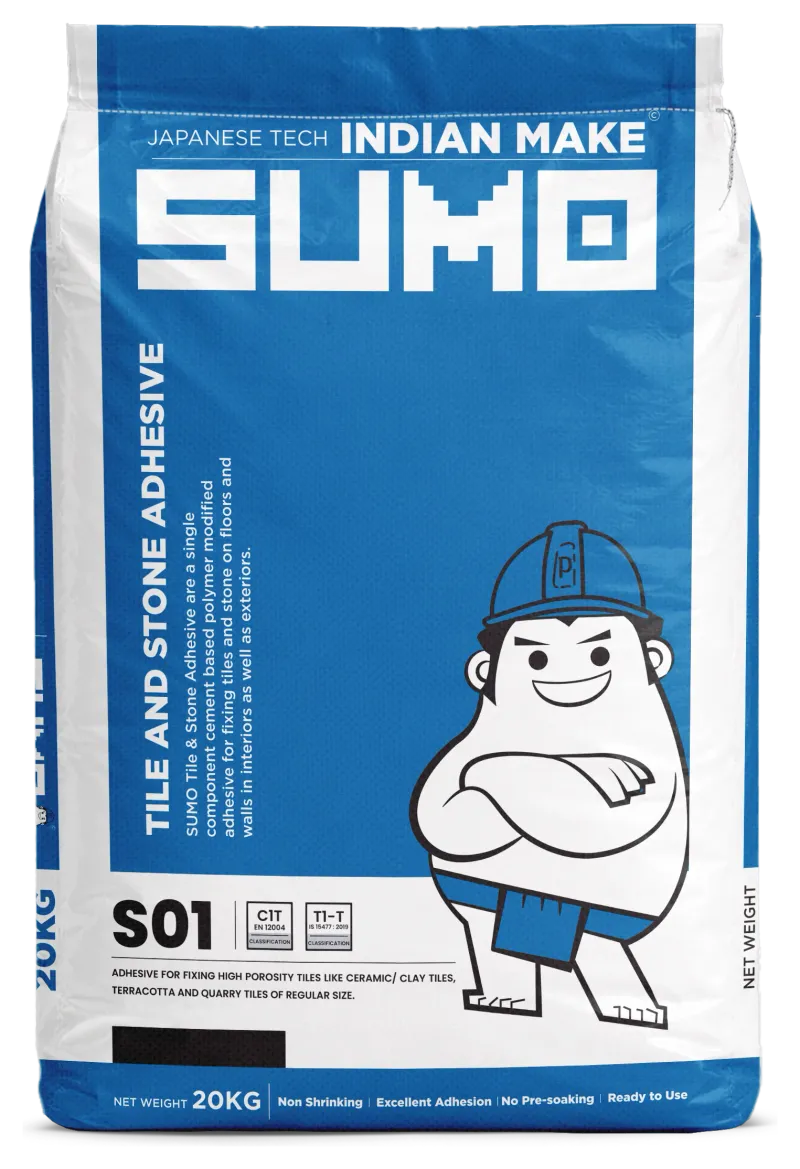
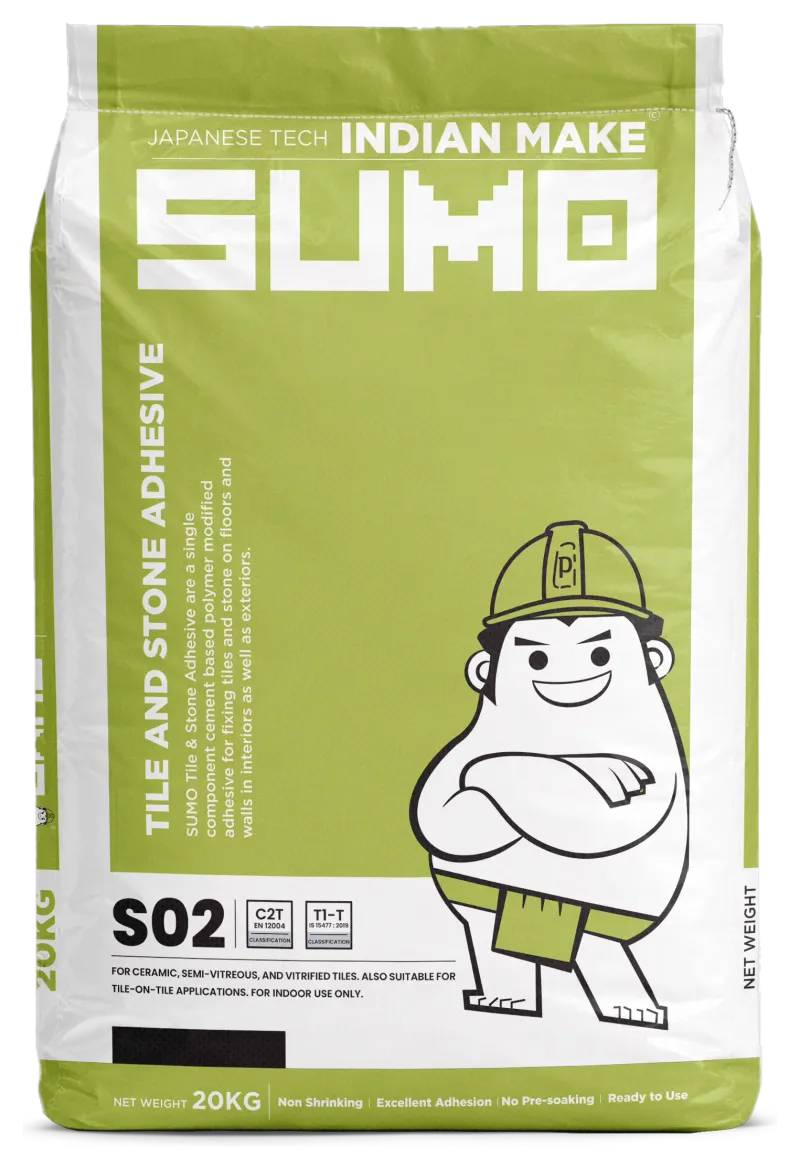
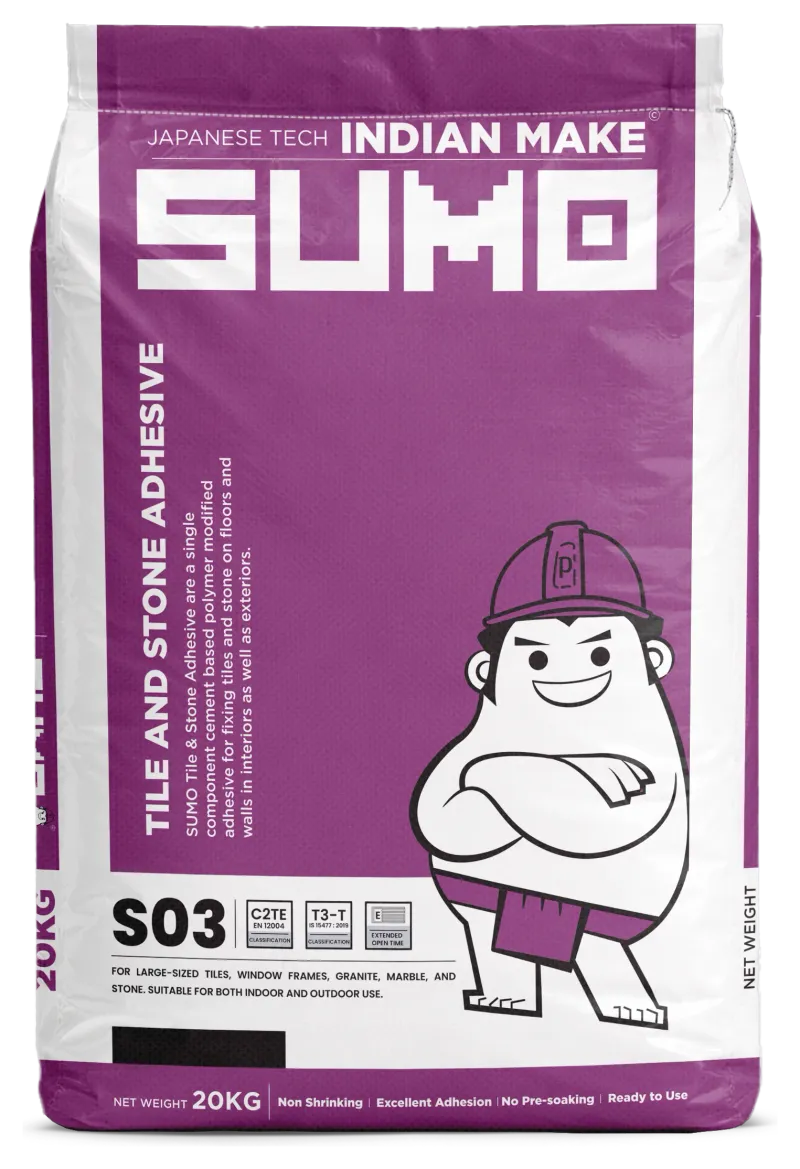
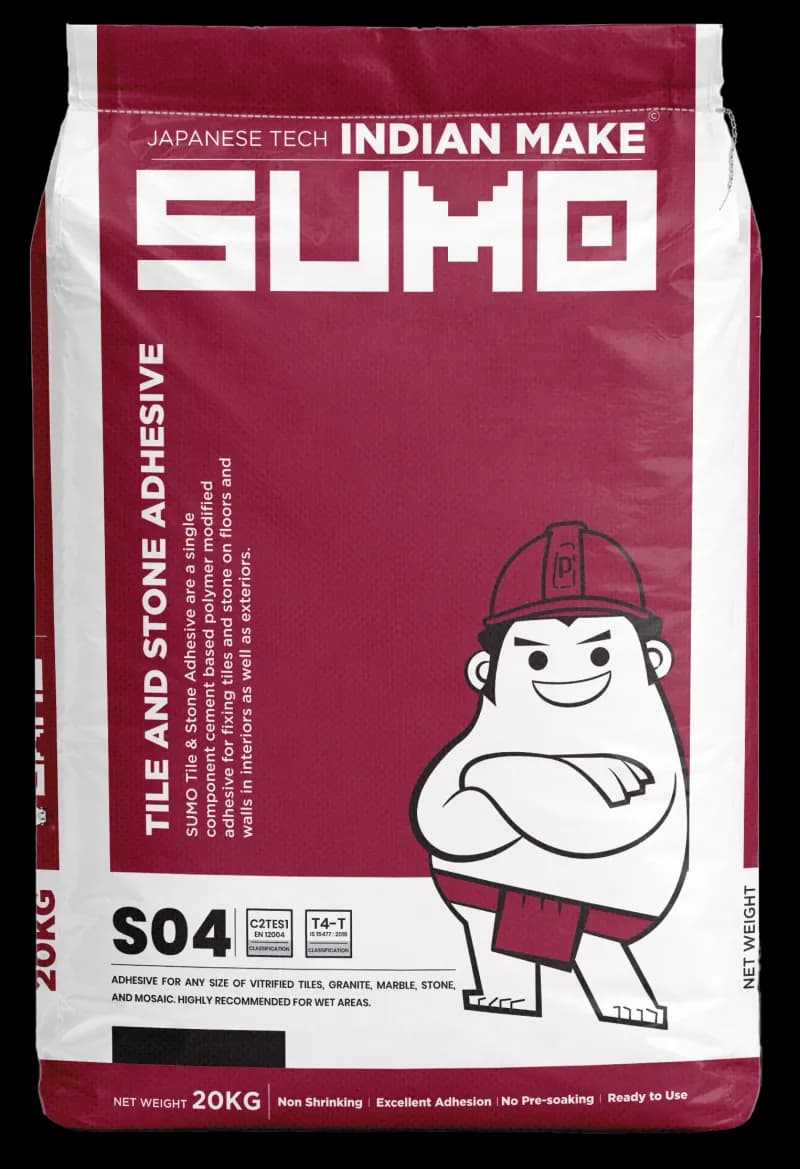
- S01 C1T · S02 C2T · S02 Plus & S03 C2TE · S04 C2TES1
KEY TAKEAWAYS
- C is the base bond: C1 ≥ 0.5 N/mm², C2 ≥ 1.0 N/mm². Dense vitrified tile, tile-on-tile and wet areas need C2.
- T stops wall slip, E keeps the bed open for 30+ minutes, S1/S2 let the cured bed flex.
- C2TE (S02 Plus, S03) covers most vitrified and stone work; C2TES1 (S04) is for large format, pools and anything that moves.
- IS 15477 : 2019 Types 1–4 map onto the same letters — SUMO bags print both.
C1, C2, T, E, S1 — a tile adhesive bag is covered in letters that look like a code. They are, and once you can read them you can tell exactly what an adhesive will and won’t do. Here is what each part of the EN 12004 classification means.
Tile adhesive grade chart: what each code means
Every SUMO bag prints its EN 12004 class and its IS 15477 : 2019 type. Read across the row for what the letters guarantee and which product carries that grade:
Grade (EN 12004) | Bond strength | T · slip | E · open time | S · flex | IS 15477 class | SUMO product | Typical use |
|---|---|---|---|---|---|---|---|
C1T | Normal — ≥ 0.5 N/mm² | Yes | — | — | Type 1 (T1-T) | S01 | Interior ceramic, terracotta and porous tiles in dry areas |
C2T | Improved — ≥ 1.0 N/mm² | Yes | — | — | Type 1 (T1-T) | S02 | Ceramic and vitrified indoors, including tile-on-tile |
C2TE | Improved — ≥ 1.0 N/mm² | Yes | Yes (≥ 30 min) | — | Type 2 (T2) · Type 3 (T3-T) | S02 Plus · S03 | Vitrified, natural stone and glass mosaic inside and out; S03 for large format and wet areas |
C2TES1 | Improved — ≥ 1.0 N/mm² | Yes | Yes | S1 deformable (≥ 2.5 mm) | Type 4 (T4-TS1) | S04 | Large format, swimming pools, heated or moving substrates, heavy-traffic floors |
C2TES2 | Improved — ≥ 1.0 N/mm² | Yes | Yes | S2 highly deformable (≥ 5 mm) | Type 4 (TS2) | — (ask for a project spec) | Extreme movement — steel decks, timber floors, façade slabs |
R2T | Reaction resin — improved | Yes | — | — | Type 5 (T5-TS2) | Flexit 2K | Metal, plywood, cement board and engineered stone |
T, E and S are only ever added on top of the base bond class — so "C2TES1" always reads as C2 + T + E + S1. Not sure which row you need? The product recommender asks four questions and picks the grade.
C1 and C2 — the base bond
The C stands for cementitious, and the number is the bond strength. C1 is a normal adhesive with a tensile bond of at least 0.5 N/mm². C2 is an improved adhesive at 1.0 N/mm² or more — the grip you want for dense vitrified tiles, natural stone and anything exterior or wet.
The suffix letters — T, E, S
- T — reduced slip: the tile stays put on a wall instead of sliding down while you work.
- E — extended open time: the combed bed stays sticky longer, so large tiles and big areas still bond.
- S1 / S2 — deformability: the cured bed can flex. S1 is deformable, S2 highly deformable — essential for large formats, heated floors and pools.
- R — reaction resin: a non-cement adhesive (PU or epoxy) for metal, ply and other difficult substrates; R2 denotes improved performance.
Reading a full grade
Put together, C2TES1 means an improved cementitious adhesive with reduced slip, extended open time and S1 deformability — SUMO S04. C2TE (S02+/S03) drops the deformability; C2T (S02) is the improved bond without extended open time; C1T (S01) is the everyday interior grade.
C2TE vs C2TES1, C1T vs C2T — which do you need?
C2TE vs C2TES1
Both are improved-bond adhesives with slip resistance and extended open time. The only difference is the S1 — the cured bed can deform by at least 2.5 mm without the bond cracking. Pick C2TE (S02 Plus, S03) for vitrified, stone and standard large-format tiles on a stable cement substrate, indoors or out. Pick C2TES1 (S04) when the substrate moves or heats: tiles over 800 mm, swimming pools and wet areas, heated floors, terraces and balconies, and heavy commercial traffic. Paying for S1 on a dry bedroom floor is wasted; skipping it under a pool tile is a failure waiting for summer.
C1T vs C2T
This one is bond strength, full stop. C1T (S01) holds at least 0.5 N/mm², C2T (S02) at least 1.0 N/mm² — double the grip. C1T is honest, economical work for porous ceramic in dry interiors. The moment the tile is dense vitrified, the job is tile-on-tile, or the area gets wet, C2T is the minimum.
C2TE vs C2T
The E buys you open time: a C2TE bed stays workable for at least 30 minutes against roughly 20 for C2T. On a 600×600 floor in April heat that is the difference between a tile bedding into sticky ridges and a tile sitting on a skin. SUMO S02 Plus is the C2TE step up from S02.
Why the class matters on site
The class is not marketing — it maps to real failure modes. Skip the T rating and wall tiles sag; skip E on a hot day and the bed skins before the tile lands; skip S1 under a 800×800 mm tile and thermal movement cracks the bond. Match the class to the job and the tile stays exactly where you left it.
Picked C2T for vitrified or tile-on-tile work? Follow the step-by-step method in how to use SUMO S02 tile adhesive — substrate prep, mixing, notch size and open time.