AAC Blocks vs Red Bricks: The Material Maths for One Wall
Eight blocks or fifty bricks per square metre — the units, mortar, weight and plaster compared with numbers, plus where bricks still make sense.
ON THIS PAGE
- Units per m² (100 mm wall)
- ≈ 8.2 blocks vs ≈ 50 bricks
- Jointing (AAC thin-bed)
- ≈ 3.7 kg/m² · 2–3 mm joints
- Jointing (brick)
- 10–12 mm sand-cement beds, site-mixed
- Density
- AAC ≈ ⅓ of fired clay brick
- Plaster after
- AAC 10–12 mm · brick 15–20 mm typical
- One block =
- ≈ 10–12 bricks by wall volume
KEY TAKEAWAYS
- A m² of partition wall: ≈ 8 AAC blocks — or ≈ 50 bricks in half-brick masonry.
- Jointing material: ≈ 3.7 kg/m² of thin-bed adhesive versus site-mixed mortar many times that mass.
- AAC is roughly a third the density of fired clay — lighter walls, lighter structure.
- Dimensional accuracy carries into the next trade: AAC walls typically plaster at 10–12 mm where brick needs 15–20.
- One block displaces roughly 10–12 bricks by volume — which is also the labour story.
Every AAC-versus-brick argument eventually lands on price per piece, which is the one comparison that tells you nothing: the two units are not the same size, do not use the same mortar, and do not leave the same wall behind for the plasterer. The comparison that matters is per square metre of finished wall. Here it is.
Units and labour: 8 versus 50
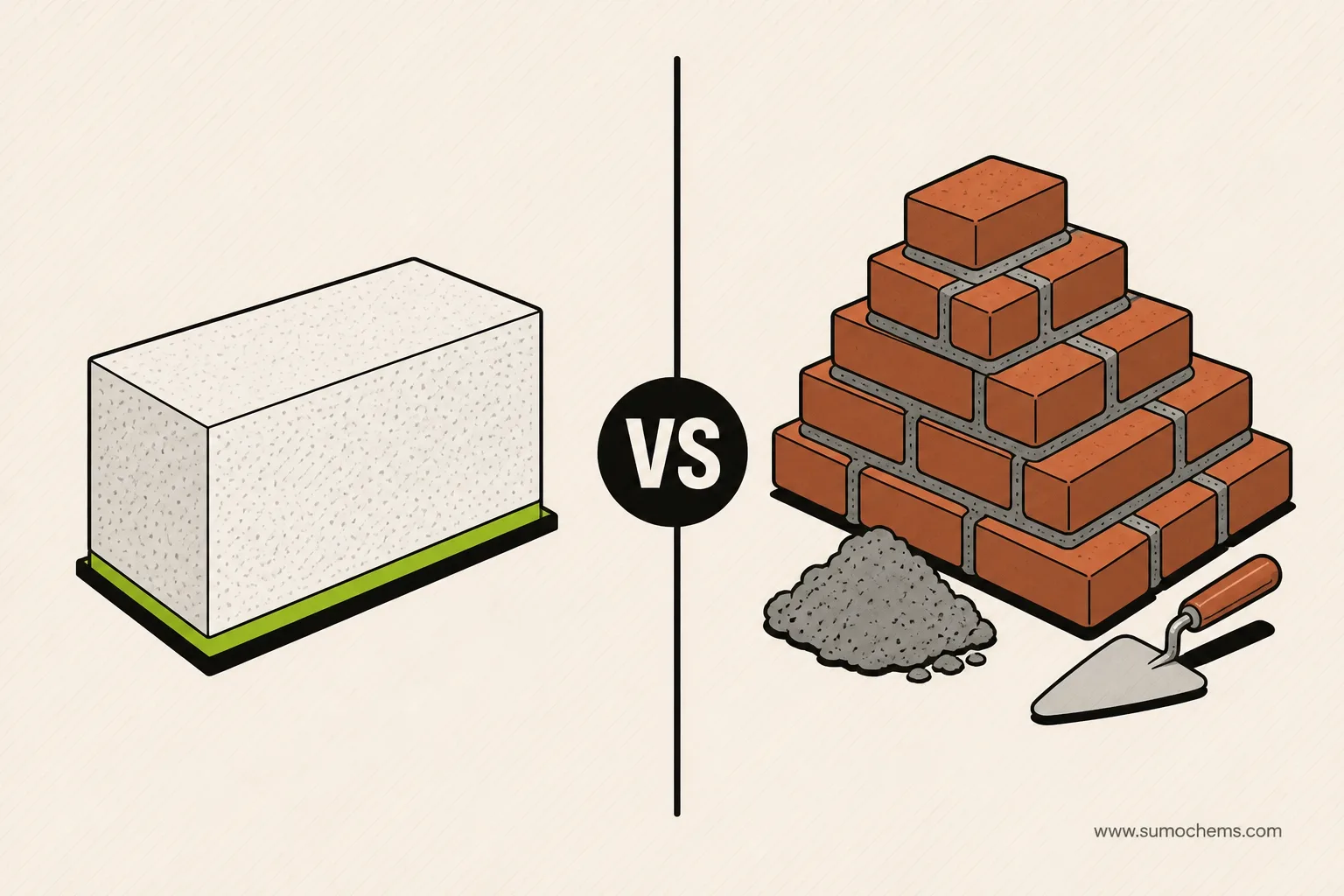
A 600 × 200 mm AAC block face covers what roughly six modular bricks cover. Per square metre of partition, that is about 8 blocks against about 50 bricks — fifty pick-place-level cycles versus eight. Walls in AAC visibly outrun brick crews for the same reason a page of large type reads faster than small: fewer pieces.
The joints: where the material maths swings hardest
Bricks are dimensionally rough, so they demand 10–12 mm sand-cement beds to absorb the variation — mortar mixed on site, from sand that arrives loose and cement batched by feel. AAC blocks are autoclave-cured to tight tolerance, so they join on a 2–3 mm bed of factory-blended jointing mortar at ≈ 3.7 kg/m² — a fraction of the jointing mass, delivered as bags, mixed with a drill. About 25–30 kg of thin-bed mortar builds an entire cubic metre of AAC masonry; brickwork spends that much mortar in a few courses.
Weight: a third the density, and the structure notices
AAC runs at roughly one-third the density of fired clay masonry. On a single partition that is convenience; across a multi-storey frame it is a genuine structural saving — lighter walls mean lighter beams and columns carrying them. It is also why AAC dominates infill walls in framed high-rise construction.
The wall it leaves behind
A brick wall’s surface inherits the roughness of its units and joints — 15–20 mm of plaster is normal to bring it true. An AAC wall built on thin-bed joints is already flat; 10–12 mm coats are routine. At ≈ 2.2 kg of ready-mix plaster per m² per mm, saving 5–8 mm of coat across every wall in a building is a second material saving that never appears in the block-versus-brick price list.
Where bricks still make sense
- Small repairs and patches matching existing brick masonry.
- Sites with established brick supply and crews where a few walls do not justify a new system.
- Applications specifically detailed for brick by the structural designer.
For everything else — and especially for framed structures and speed-driven projects — the per-m² maths favours the block. Count your own wall with the AAC Block Calculator under Tools & Support: it returns blocks and thin-bed mortar bags in one pass, openings deducted.