Tile adhesive vs cement mortar: strength, cost per sq.ft and when each one is right
Cement mortar holds tiles by soaking into them — and modern vitrified tiles do not soak. How the two methods bond, what each really costs per sq.ft once you count the whole bed, and the jobs where one is simply wrong.

ON THIS PAGE
- Mortar bed
- 20–25 mm on floors
- Adhesive bed
- 3–10 mm, combed
- C1 / C2 bond
- ≥ 0.5 / ≥ 1.0 N/mm²
- Vitrified absorption
- < 0.5 %
- 20 kg bag covers
- ≈ 50 sq.ft @ 3 mm · 32 @ 10 mm
- Vitrified minimum
- S02 (C2T)
KEY TAKEAWAYS
- Sand-cement bonds by soaking into porous tile backs; vitrified and porcelain tiles absorb under 0.5% water, so cement only forms a weak surface film that lets go after a monsoon or two.
- Tile adhesive bonds with polymers and carries a rated tensile strength: C1 ≥ 0.5 N/mm², C2 ≥ 1.0 N/mm² — tested after water, heat and freeze–thaw.
- Compare the whole bed, not the bag: a 20–25 mm mortar bed uses 2–8× the material of a 3–10 mm adhesive bed, needs a week of curing and slower labour.
- Cement is still fine for porous ceramic and terracotta on small dry interiors; adhesive is the only sensible choice for vitrified, large-format, wall, tile-on-tile and wet-area work.
Ask ten masons whether to fix tiles with cement or with tile adhesive and you will get two confident answers and one honest one: it depends on the tile. Sand-cement mortar built most of India's floors and, on the right tile and the right substrate, it still works. But the tile itself has changed. The dense vitrified tile that now goes into almost every new home was never designed to be stuck with cement, and that single fact explains most of the hollow, popping and cracked tiles that show up two monsoons later.
This article puts the two methods side by side — how each one actually holds a tile, what they cost once you count the whole bed and not just the bag, and the jobs where one of them is simply the wrong choice.
How each one holds the tile
Sand-cement mortar bonds mechanically. The wet mortar bed is laid thick — typically 20 to 25 mm on a floor — and the back of the tile is dipped in cement slurry and pressed in. As the cement hydrates it locks into whatever it can grip: the pores on the back of the tile and the roughness of the screed. That is why it works well on clay tiles, terracotta and old porous ceramic: their backs are open and thirsty, and the cement keys into them.
Tile adhesive is a factory-blended mix of cement, graded sand, polymers and water-retaining additives. It is combed out as a thin ridged bed — 3 mm on a small tile, up to 10 or 12 mm on a large one — and the polymers do the job the pores used to do. They wet the surface, grip a dense back that has no pores, and give the cured bed a little flexibility so it can follow the tile through heat and moisture cycles. That is the whole point of the C1 / C2 grades printed on the bag: they are a measured bond strength, not a marketing claim.
The vitrified tile problem
A vitrified tile absorbs less than half a percent of its weight in water — it is nearly glass. Cement slurry cannot soak into it and there is almost nothing to key into. The tile sits on the mortar rather than being held by it. It feels solid on day one because the bed is stiff, but the bond is only a weak surface film, and the tile and the mortar bed move at different rates every summer and every monsoon. Eventually the film lets go: the tile sounds hollow, then a corner lifts, then it pops.
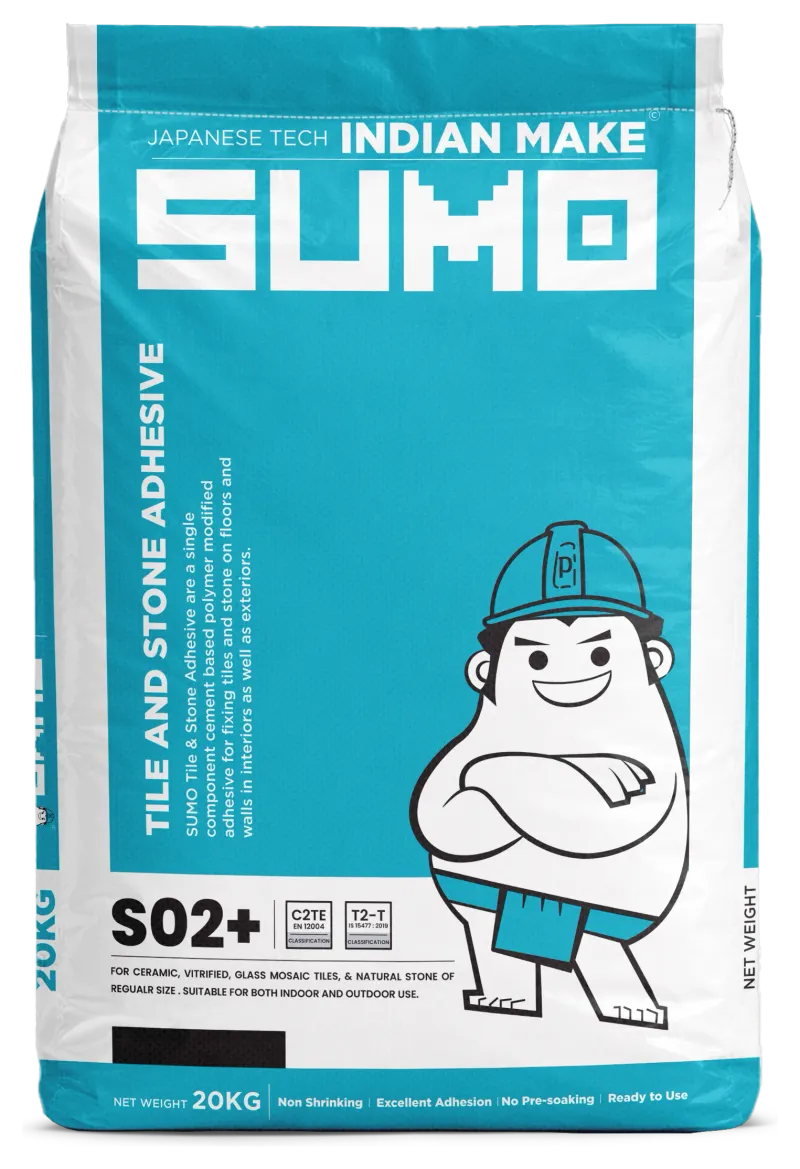
This is not a workmanship failure, and a better mason with the same cement will get the same result. Dense tiles need a polymer bond, which is what a C2-grade adhesive is for. SUMO S02 (C2T) is the minimum for vitrified tile indoors; S02 Plus (C2TE) adds the extended open time that stops the bed skinning on a hot floor.
Strength: what the numbers actually say
Tile adhesive is tested for tensile bond — how hard you have to pull to lift a fixed tile straight off. A C1 adhesive holds at least 0.5 N/mm², a C2 adhesive at least 1.0 N/mm², and the test is repeated after water immersion, heat ageing and freeze–thaw so the number still stands after a monsoon and a summer.
Sand-cement has no such rating, because the bond depends entirely on the tile and the site: the mix ratio, how much water the mason added, how thirsty the tile back is and whether the bed was cured. On a porous ceramic with a well-cured bed it can hold well. On a vitrified tile it is a fraction of a C1 figure, and nobody can tell you the number in advance.
The other difference is what happens to a thick bed as it dries. A 25 mm sand-cement bed shrinks as it cures; a tile fixed on it is fighting that shrinkage from the first week. A 3 to 10 mm adhesive bed with polymers barely shrinks, and what movement there is, the bed absorbs.
Cost per square foot, done honestly
Per bag, cement is cheaper than adhesive and the argument usually stops there. It should not, because the two beds are not the same size.
- A sand-cement floor bed is 20–25 mm thick. A tile adhesive bed is 3–10 mm. The mortar job uses two to eight times more material by volume, plus the sand, plus the water to cure it.
- A 20 kg bag of SUMO S-series adhesive covers about 50 sq.ft at a 3 mm bed and about 32 sq.ft at 10 mm (4.3 kg/m² at 3 mm, scaled for the notch). The tile adhesive calculator turns your area and bed thickness into bags.
- Sand-cement needs the substrate hacked or roughened, the bed laid, the tile slurried and set, and then a week of wet curing before anyone works on it. Adhesive goes on a clean, level surface straight from the bucket and the floor is typically ready for grouting the next day (check the datasheet for the grade you are using).
- Labour is the largest line on most Indian tiling jobs. A tiler on adhesive lays more tiles per day because there is no bed to build and no slurry to dip, and the thin bed makes it far easier to keep the floor flat.
- Then there is the cost that never appears on the estimate: the hollow tile that pops in year two, the mismatched replacement, and the whole floor that gets redone because ten tiles let go.
Put the whole bed, the labour and the risk on the same sheet and adhesive is usually the cheaper way to fix a vitrified floor. Sand-cement is cheaper only where the tile is porous, the area is small and the labour is your own.
Where cement mortar is still the right call
Sand-cement is not a bad material — it is a bad match for dense tiles. It remains a reasonable choice when:
- the tile is porous — terracotta, clay, quarry tile, old-style ceramic with a deeply pitted back;
- the floor is badly out of level and you are using the mortar bed to build it up, which no adhesive should be asked to do;
- the job is a small, dry, interior area with no thermal movement, and a week of curing time is not a problem.
Even then, a polymer-modified slurry improves the bond, and if the floor needs levelling first, a screed followed by adhesive is the more reliable build-up than one thick mortar bed doing both jobs.
Where tile adhesive is the only sensible choice
- Vitrified, porcelain and glazed tiles of any size. No pores, no cement bond.
- Large-format tiles, 600×600 mm and up. A thick mortar bed under a big tile is a hollow tile waiting to happen; a combed and back-buttered adhesive bed is the only way to get 95% coverage.
- Wall tiles. A cement-slurried wall tile slides; a T-grade adhesive (every SUMO S-series grade carries the T) holds it in place while you work.
- Tile-on-tile renovation. Cement cannot grip a glazed surface. A C2T adhesive over a cleaned, sound old floor can — see fixing tile on tile.
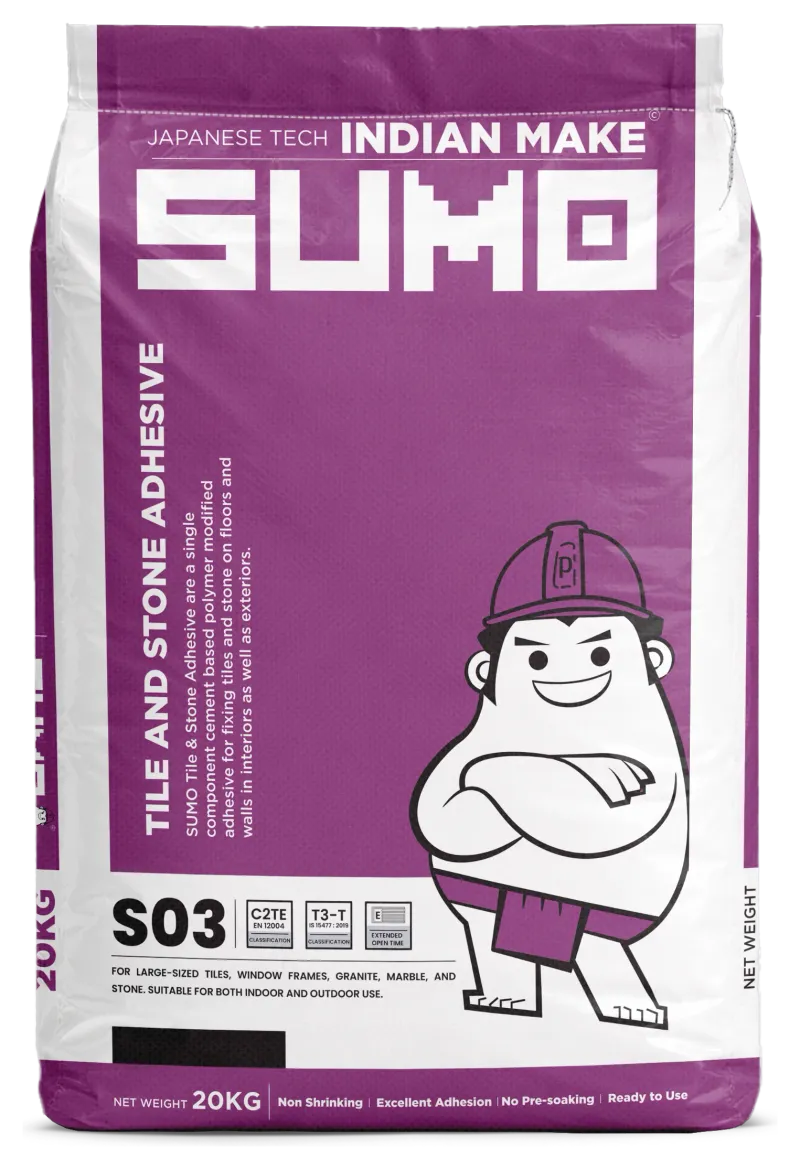
- Wet areas, terraces and exteriors. The bed has to survive water and heat cycles; use C2TE — S03 for large format and wet areas — or C2TES1 (S04) where the substrate moves.
- Natural stone and glass mosaic. Polymer bond plus, for stone, a white or non-staining adhesive.
Comparison at a glance
| Sand-cement mortar | Tile adhesive (SUMO S-series) |
|---|---|---|
How it bonds | Mechanical key into porous tile backs | Polymer bond, works on dense and non-porous tiles |
Bed thickness | 20–25 mm on floors | 3–10 mm, combed with a notched trowel |
Rated bond strength | None — varies by tile and site | C1 ≥ 0.5 N/mm² · C2 ≥ 1.0 N/mm² (EN 12004 / IS 15477) |
Vitrified & porcelain | Poor — weak surface film, tiles pop later | Correct choice (C2 grade minimum) |
Porous ceramic, terracotta | Works | Works (C1 grade is enough) |
Large format 600 mm+ | Hollow-prone | Comb + back-butter, 95% coverage |
Wall tiles | Slides, needs support | T grade holds without slip |
Tile-on-tile | Not possible | C2T and above |
Curing before use | About a week, kept wet | Typically next day (see datasheet) |
Material per sq.ft | High — thick bed plus sand | Low — one 20 kg bag ≈ 32–50 sq.ft |
Labour speed | Slow: hack, bed, slurry, set, cure | Fast: comb, set, grout |
Failure risk on modern tiles | High after 1–2 monsoons | Low when grade matches the tile |
Which SUMO grade replaces your cement mix
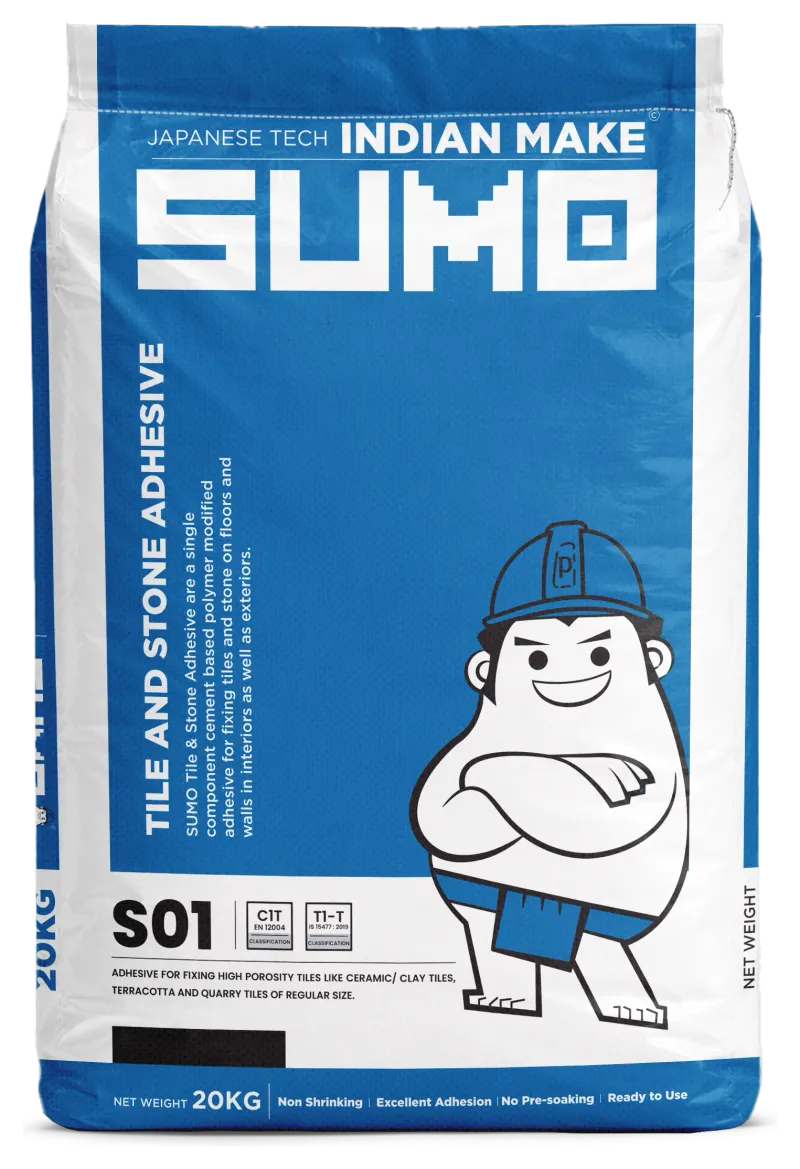
- Porous ceramic, dry interior: S01 (C1T) — the direct replacement for a slurry job, at a fraction of the bed.
- Vitrified tile indoors, tile-on-tile: S02 (C2T).
- Vitrified, natural stone, glass mosaic, inside or out: S02 Plus (C2TE).
- Large format, wet areas, exteriors: S03 (C2TE, IS 15477 Type 3).
- Pools, heated or moving substrates, heavy traffic: S04 (C2TES1).
If you are unsure which row you are in, the product recommender asks four questions and picks the grade; the tile adhesive grade decoder explains what each code guarantees.
The short version
Cement mortar holds porous tiles by soaking into them. Modern tiles do not soak. If the tile is vitrified, porcelain, large, on a wall, over an old floor or anywhere wet, tile adhesive is not the premium option — it is the only one that will still be holding in five years. Use sand-cement where the tile is porous and the floor needs building up, and count the whole bed, not the bag, when you compare the cost.