Tile adhesive: the complete guide to grades, standards and choosing the right one
Everything about tile adhesive in one place — what it is, why it replaced cement mortar, the history, which grade each tile and substrate needs, and how IS 15477:2019 and EN 12004 certification actually work.

ON THIS PAGE
- What tile adhesive actually is
- Types of tile adhesive
- Why tile adhesive had to be invented
- A short history of tile adhesive: the timeline
- Tile adhesive vs cement mortar: the honest comparison
- Which tile needs which type of tile adhesive
- The best tile adhesive for each common job
- How to use tile adhesive: the method, step by step
- Technical specifications compared
- Certification: who decides what, and why the standards differ
- How to read the grade on a SUMO bag
- Coverage, consumption and doing the cost maths properly
- Why tile adhesive fails — and it is rarely the adhesive
- A buying checklist
- Tile adhesive glossary
- Indian standard
- IS 15477:2019 · Type 1–5
- European standard
- EN 12004-1:2017 · C1–C2, R
- C1 vs C2 tensile
- ≥0.5 vs ≥1.0 N/mm²
- Deformability
- S1 2.5–5 mm · S2 ≥5 mm
- Typical bed
- 3–6 mm thin-bed
- Coverage
- 40–50 sq.ft per 20 kg @ 3 mm
- Open time
- ~20 min · ~30 min (E grade)
KEY TAKEAWAYS
- Tile adhesive is a thin-bed factory-blended mortar whose polymer content — not its brand — decides what it can bond.
- Modern vitrified tiles are near-zero porosity, so cement slurry has nothing to key into: this is the root cause of hollow, drumming floors.
- The grade code is the specification: 2 means double the bond, T means it will not slide on a wall, E buys working time in the heat, S1/S2 mean it can flex.
- IS 15477:2019 (Types 1–5, T, S1/S2, BIS licence) and EN 12004-1:2017 (C/D/R, 1/2, F/T/E/S1/S2) describe the same products against different test conditions — India conditions at 27 °C and 65% RH, which is why E matters so much here.
- Tile porosity, tile size, substrate and exposure each push you up the grade ladder — match all four, not just the budget.
- Most failures are process failures: skinned beds, poor coverage, dirty substrates and missing movement joints.
Tile adhesive is a factory-blended, cement-based (or resin-based) mortar designed to bond a tile to a substrate in a thin bed — typically 3 to 6 mm — instead of the 20 to 40 mm bed of sand and cement that Indian sites used for a century. It is the single component in a tiling job that decides whether the floor is still silent and intact in ten years, or drumming hollow in two.
This guide covers the whole subject in one place: what tile adhesive actually is, why it had to be invented, how it compares with traditional cement mortar, which adhesive each type of tile and substrate needs, and — the part almost nobody explains properly — what the certification codes on the bag mean, who decides them, and why the Indian standard and the European standard don't say the same thing.
What tile adhesive actually is
Open a bag of good cementitious tile adhesive and you are looking at four things that have been dry-blended in a precise ratio:
- Portland cement — the binder. It hydrates and hardens, the same reaction as in any concrete.
- Graded silica sand — the filler, screened to a narrow particle size so the bed builds consistently and combs cleanly.
- Water-retaining polymers — the quiet hero. They hold mixing water in the bed long enough for the cement to hydrate properly, even against a thirsty tile or a dry screed, and they give the mix its buttery, non-slumping body.
- Bonding polymers — these re-form into a flexible film as the mortar dries. This is what turns a brittle cement mortar into an adhesive that grips glass-smooth vitrified tile and survives movement.
Change the polymer content and you change the class of the product. That's essentially the entire ladder from C1 to C2 to S1 to S2: how much polymer, and how good.
Reaction-resin adhesives (epoxy or polyurethane, the "R" class) work differently — no cement, no water, just two or three components that cure chemically into a plastic. They are for the hard cases: metal, plywood, chemical exposure, extreme movement.
Types of tile adhesive
"Tile adhesive" is a category, not a product. Before you can pick one, it helps to know how the category divides — because Indian sites use one branch of it almost exclusively, and buyers often don't realise the others exist.
By chemistry
Cementitious tile adhesive (C). Powder in a bag, mixed with water on site. Cement binder, graded sand, polymers. This is more than nine out of ten bags sold in India, and everything from C1T up to C2TES2 sits in this family. Sold in 20 kg bags, mixed in a bucket with a paddle mixer, applied with a notched trowel.
Dispersion or ready-mixed tile adhesive (D). A paste that arrives pre-mixed in a tub, drying by evaporation rather than by hydration. Convenient for small wall repairs and light interior ceramic, but it cannot be used in wet areas, under heavy tiles, or externally. Rare on Indian sites and not part of the SUMO range.
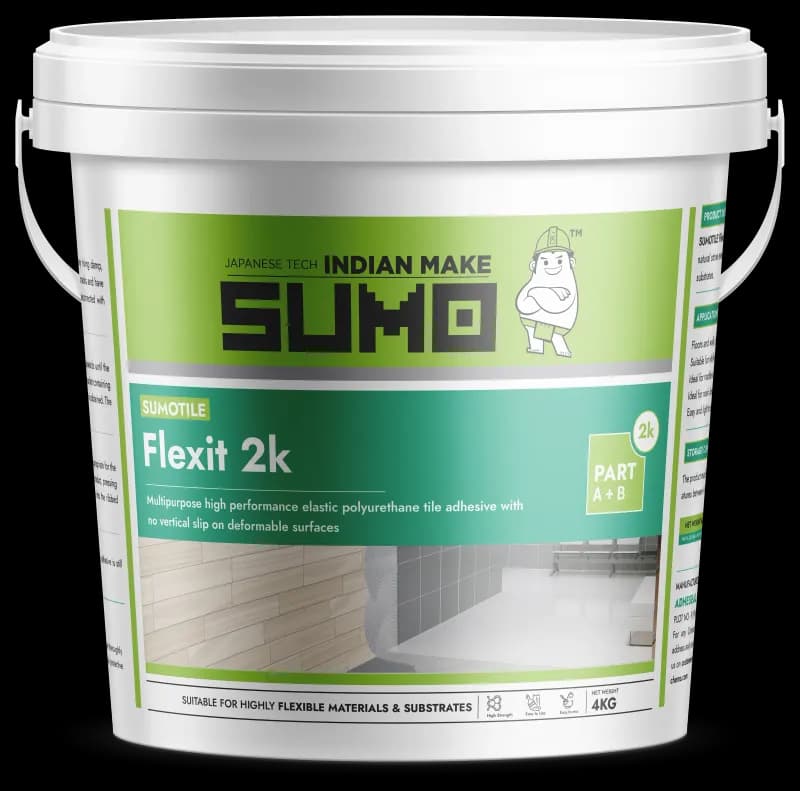
Reaction-resin tile adhesive (R). Epoxy or polyurethane, supplied as two or three components that must be mixed in the correct ratio. It cures chemically, so it bonds to surfaces cement will never grip — steel, aluminium composite, plywood, fibreglass, old membranes — and it resists chemicals and constant water. SUMO Flexit 2K is the R2T adhesive in the range; Sumoxy Powerbond and Sumoxy Ultrabond are epoxy bonding systems for multi-material work.
By bed thickness
Thin-bed adhesive — the standard case, a 3 to 6 mm bed over a flat, true substrate. Almost every bag on the market is designed for this.
Medium-bed use — thicker beds, roughly 6 to 12 mm, for large slabs and slightly uneven backgrounds. A high-polymer C2 adhesive handles this, but do not treat adhesive as a levelling material: correcting more than about 12 mm with adhesive is expensive, slow to cure and prone to shrinkage. Level the substrate first.
Thick-bed mortar — 20 mm and up, a different product and a different method entirely. Valid for screeding and for porous traditional tiles, not for porcelain.
By colour
Grey tile adhesive is the default and the cheaper option — right for almost all floors and for any tile that is opaque.
White tile adhesive matters more than people expect. Glass mosaic, onyx, white marble, translucent engineered stone and any thin light-coloured tile will show the bed through the body of the tile. A grey bed under white marble reads as a permanent dirty shadow. SUMO S03 and S04 are both available in grey and white for exactly this reason.
By format
Bagged adhesive — the complete product, ready to mix.
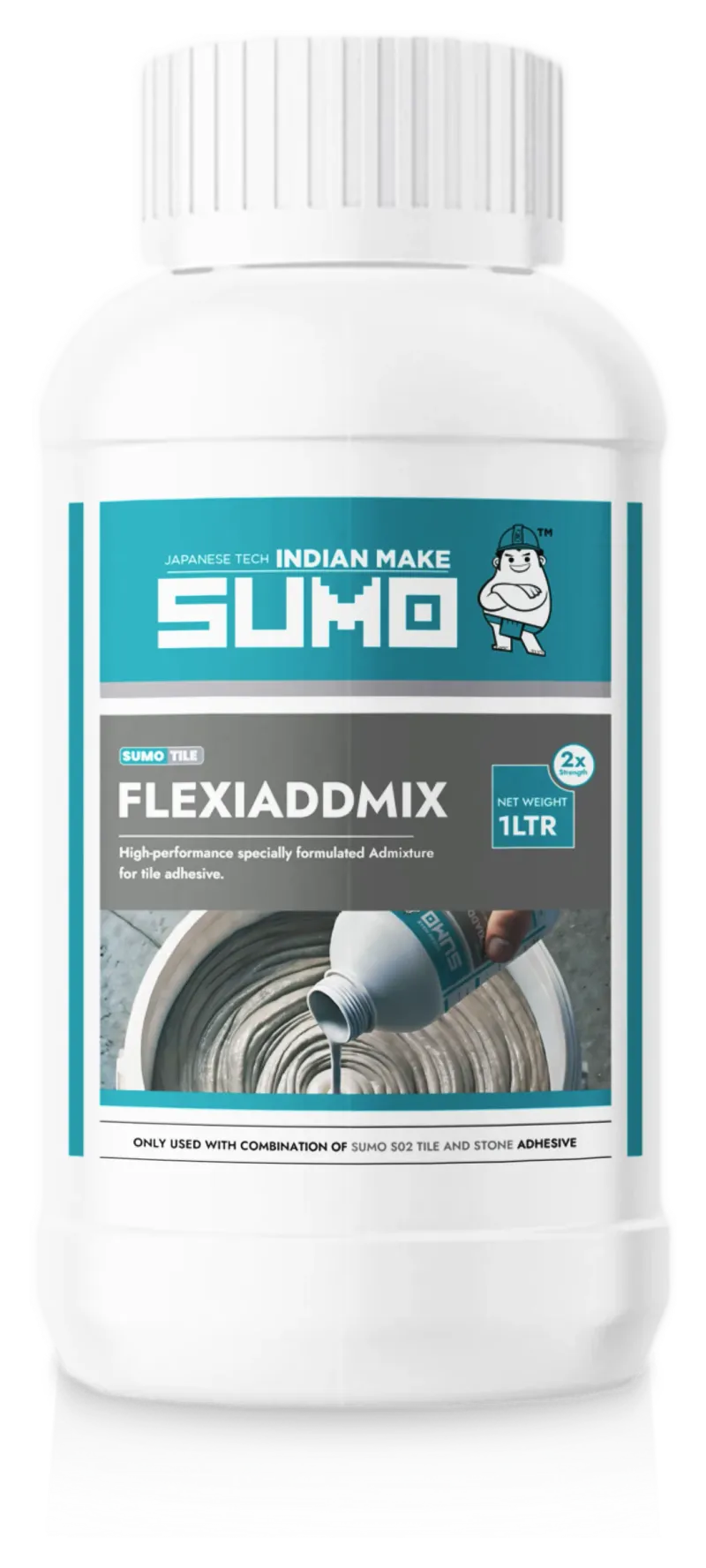
Admixtures and boosters — liquids that upgrade what is already in the bucket. Flexiaddmix replaces the gauging water in S03 and takes the mix up to C2TES2 / IS Type 4-TS2, the highest deformability class, without changing bags. Tile Bonder is a slurry booster for cement-based mixes. These matter when one difficult area on a site needs a higher grade than the rest of the job.
Why tile adhesive had to be invented
For most of tiling history, tiles were laid in a thick bed of sand and cement, wet, on a soaked substrate, with a cement slurry gauged onto the back of the tile. That worked for a specific kind of tile: porous, hand-made, water-absorbent ceramic and terracotta. Water absorption is the key. A porous tile sucks moisture out of the slurry, cement crystals grow into the tile's own pore structure, and you get a mechanical key. The tile is effectively locked into the mortar by its own texture.
Then the tile changed.
Modern vitrified and full-body porcelain tiles are fired to near-zero porosity — typically under 0.5% water absorption. There is nothing for cement slurry to key into. The back of the tile is essentially glass. Put a modern porcelain tile onto traditional cement slurry and the only thing holding it up is friction and hope. That is the root cause of the hollow, drumming, popping floors seen across Indian buildings.
At the same time tiles got bigger — from 1x1 ft ceramic to 2x4 ft and 4x8 ft slabs — and buildings got faster, taller and more thermally stressed. A thick sand-cement bed shrinks as it dries, and a large rigid tile on a shrinking bed has nowhere to go but off.
Tile adhesive solves both problems chemically instead of mechanically: the polymer film bonds to a non-porous back, and the thin bed removes most of the shrinkage.

A short history of tile adhesive: the timeline

Antiquity to the 1940s — the thick bed. Roman, Persian and Indian tiling all used the same principle: a deep mortar screed, laid wet, tile bedded into it. Skilled, slow, heavy, and entirely dependent on the mason.
Late 1940s–1950s — the thin-bed idea. In the United States, chemical engineer Dr Henry M. Rothberg, working from his family's floor-covering business, began investigating whether synthetic latex — already being used in concrete — could let tiles be fixed in a thin bed. The result was a latex thin-set additive taken to market in the 1950s, and with it a new industry: thin-bed tile installation. In parallel, water-retaining polymers made "dry-set" mortars possible — mortars that could be mixed with water alone and would hold that water long enough to cure without soaking the tile first.
1950s–1960s — the first standards. The American National Standards Institute codified the new materials: ANSI A118.1 for dry-set cement mortar (unmodified) and later ANSI A118.4 for modified dry-set mortar. For the first time, "tile adhesive" meant something testable rather than a recipe.
1960s–1980s — Europe industrialises thin-bed. German and Central European manufacturers built the dry-mix mortar industry around the Dünnbett (thin-bed) method, adding bonding polymers to make bagged, just-add-water adhesives. National standards proliferated — DIN in Germany, BS in the UK — which is exactly the fragmentation that later forced a common European standard.
1990s — porcelain arrives at scale. Cheap, hard, near-zero-porosity vitrified tile becomes the global default. Adhesive chemistry has to keep up; the C2 "improved" class and the deformable S-classes become commercially important rather than exotic.
2001 — EN 12004. CEN publishes the harmonised European standard Adhesives for tiles, introducing the letter-and-number classification the world now recognises: C1, C2, plus optional F, T, E, S1 and S2. It is revised in 2007 (with an amendment in 2012) and again in 2017, when it splits into EN 12004-1 (requirements and classification) and EN 12004-2 (test methods).
2004 — India's first standard. The Bureau of Indian Standards publishes IS 15477:2004, Adhesives for use with ceramic tiles and mosaics — India's first proper specification for the product, at a point when most of the market was still using site-mixed cement slurry.
2010–2014 — the international layer. ISO publishes the ISO 13007 series (Ceramic tiles — Grouts and adhesives), aligning the classification globally: Part 1 terms/definitions/specifications for adhesives, Part 2 test methods, Parts 3 and 4 for grouts.
2019 — India rewrites its standard. BIS publishes IS 15477:2019, a substantial revision that widens the scope to ceramic, mosaic and stone tiles, classifies adhesives into Type 1 to Type 5, and adds slip resistance (T) and deformability (S1 / S2) classifications alongside tensile and shear adhesion strength, open time and adjustment time. BIS issues a product manual the same year setting out how licences under the standard are to be operated.
2020s — certification becomes an entry ticket. Tile adhesive moves from a voluntary-standard product to one where BIS licensing and the ISI mark are the baseline expectation for institutional supply, government work and serious specification. Simultaneously, large-format slabs, rooftop and façade tiling and heated/exposed screeds push volume demand toward C2TE and C2TES1 grades.
Where India is today. The Indian market still buys a lot of adhesive on price per bag rather than on grade, and site-mixed cement slurry is still used under vitrified tile in the price-sensitive segment. That gap between what the tile needs and what it gets is, in one sentence, why this article exists.
Tile adhesive vs cement mortar: the honest comparison
This is the question every buyer asks, usually phrased as "adhesive is expensive, why not cement?" Here is the real answer.
| Traditional cement–sand mortar | Tile adhesive (thin-bed) |
|---|---|---|
Bond mechanism | Mechanical key into a porous tile back | Chemical + mechanical; polymer film grips non-porous backs |
Bed thickness | 20–40 mm | 3–6 mm typical (up to 12 mm with medium-bed grades) |
Works on vitrified/porcelain? | Poorly — nothing to key into | Yes, this is what it is designed for |
Mix control | Site-gauged, varies by mason, by the hour | Factory-blended, same every bag |
Water demand | High; needs tile soaking and curing | Just add water; no tile soaking |
Shrinkage | Significant — thick bed dries and shrinks | Minimal — thin bed |
Dead load | Heavy; matters on upper floors and façades | A fraction of the weight |
Hollowness risk | High if the slurry skins or coverage is patchy | Low with correct notch and open-time discipline |
Coverage per unit | Deceptively cheap by the bag | ~40–50 sq ft per 20 kg bag at 3 mm bed |
Speed | Slow; curing and levelling on site | Fast; grout in ~24 hours in most cases |
Skill dependence | Very high | Moderate — the bag carries the chemistry |
The cost point, properly framed. Compare cost per square foot installed, not cost per bag. A thick bed consumes far more material by volume and far more labour hours, and it puts several kilos per square foot of dead weight onto the structure. Once you count sand, cement, labour, water and the cost of redoing hollow tiles, the adhesive route is usually competitive and frequently cheaper — and it is the only route that is technically valid under a low-porosity tile.
Where cement mortar is still legitimate: thick levelling beds, screeds, and traditional porous tiles like terracotta, quarry tile and Kota over a properly prepared base. Even then, a bonding admixture or a slurry booster changes the outcome substantially.
For the full side-by-side — bond mechanism, bed thickness, rated strength and the cost per square foot done honestly — read tile adhesive vs cement mortar: strength, cost and when each is right.
Which tile needs which type of tile adhesive
The choice is driven by four things, in this order: tile porosity, tile size, the substrate, and the exposure. Each one pushes you up the grade ladder.

By tile type
Tile | What it demands | Minimum sensible grade |
|---|---|---|
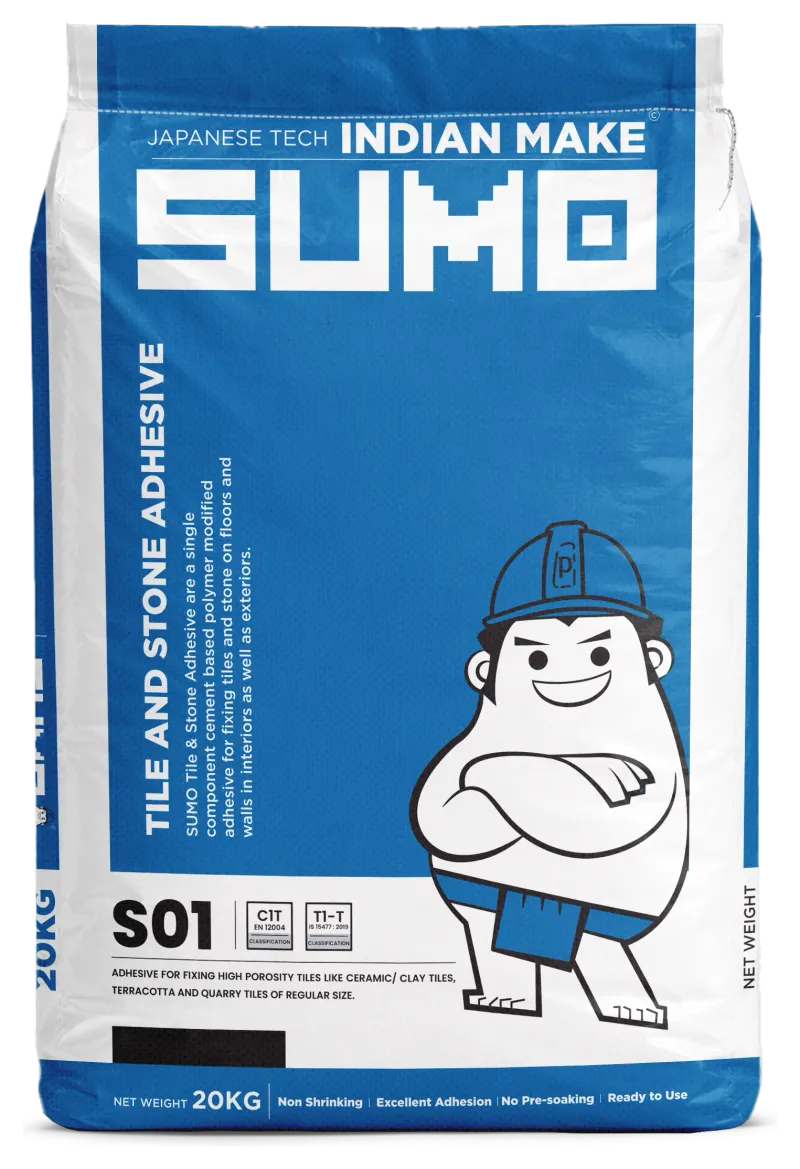
Ceramic wall/floor, terracotta, quarry (porous, >3% absorption) | Basic bond, slip resistance on walls | C1T — SUMO S01 |
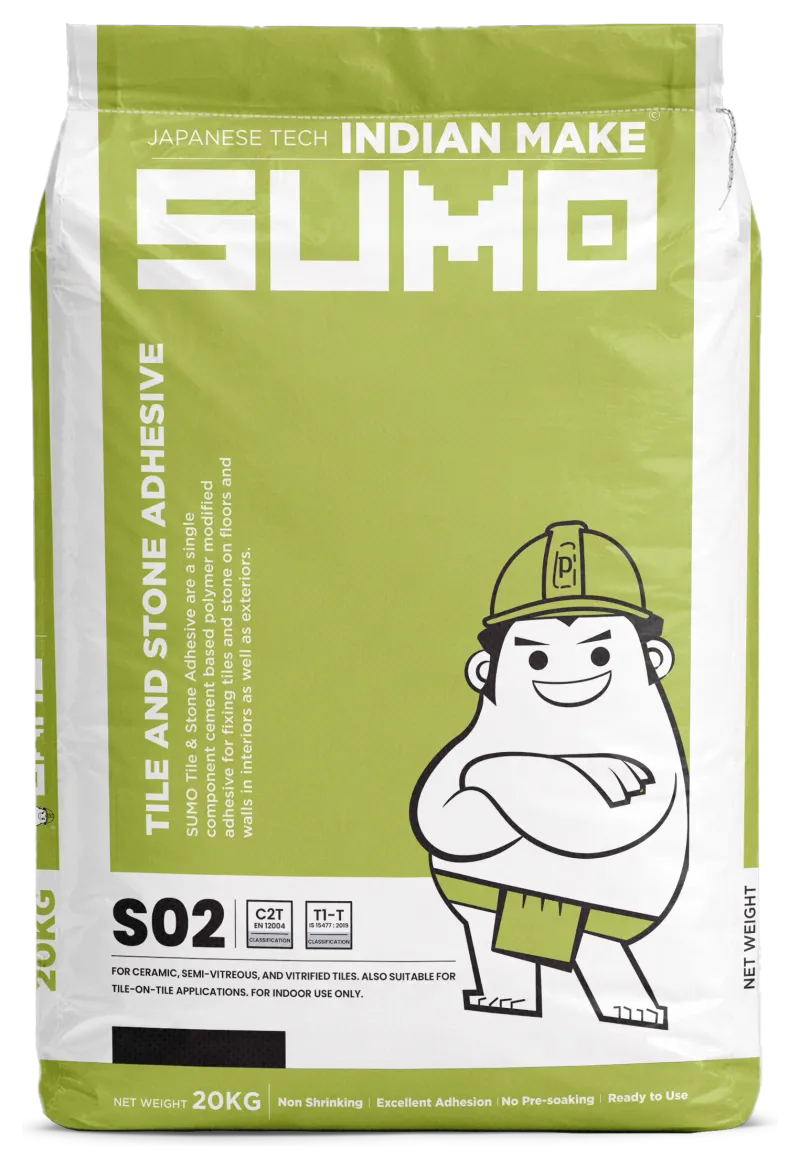
Vitrified / porcelain, regular format, interior | Improved bond onto a non-porous back | C2T — SUMO S02 |
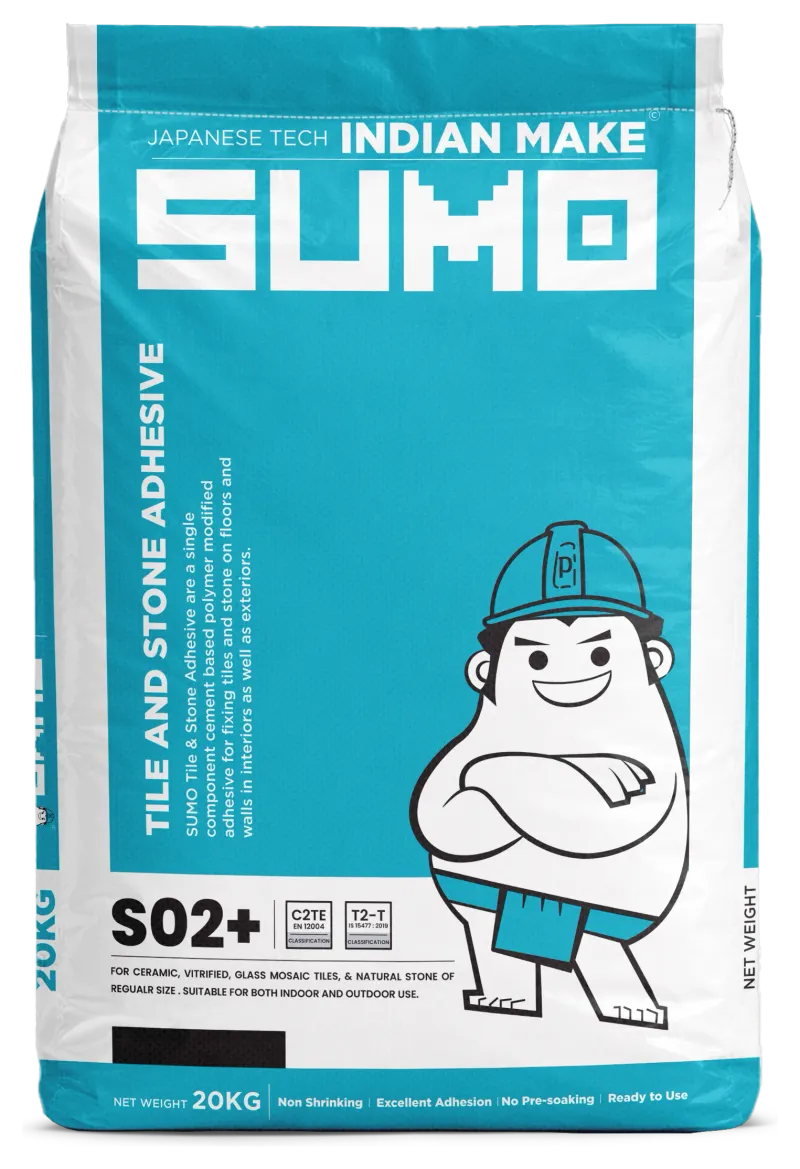
Vitrified, natural stone, glass mosaic, interior + exterior | Improved bond plus a longer working window | C2TE — SUMO S02 Plus |
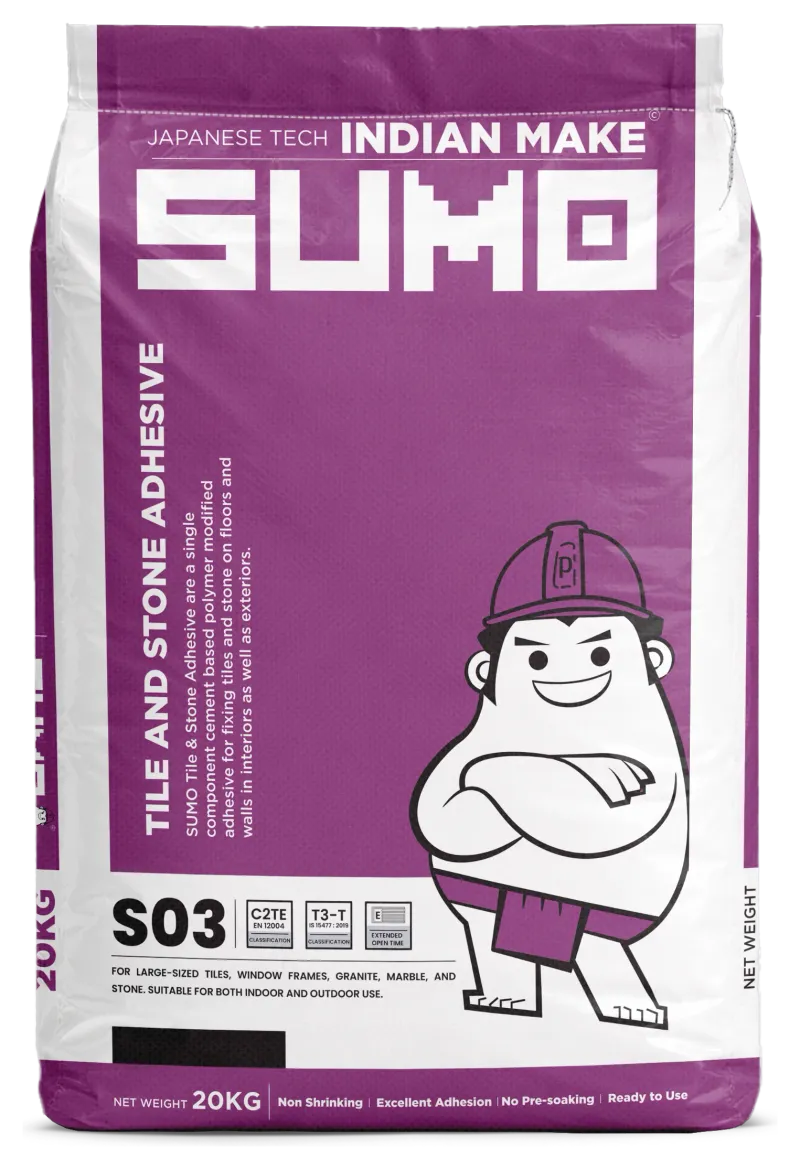
Large-format tiles and slabs, stone, wet or dry, in or out | High grip, extended open time, full coverage | C2TE — SUMO S03 |
Pools, wet areas, heavy-traffic commercial, big slabs on moving backgrounds | Improved bond + deformability | C2TES1 — SUMO S04 |
Tiles on metal, plywood, cement board, engineered stone | Resin chemistry, highest deformability | R2T — SUMO Flexit 2K |
Two extra rules that matter more than people expect:
- Glass mosaic and translucent stone need a white or light adhesive, because the bed shows through. Check the shade before you check the grade.
- Natural stone — marble, granite, and especially green marble and some limestones — can stain or warp if it gets too much water from the bed. Use a low-water, polymer-rich adhesive, never a wet slurry, and never soak the stone.
By tile size
Size changes two things: the notch you need and the movement the bed has to absorb.
- Up to 300 x 300 mm: 6 mm square-notch trowel, straight bed.
- 300 x 600 mm to 600 x 600 mm: 10 mm notch, and back-buttering becomes good practice.
- Above 600 mm, and any slab: 12 mm notch minimum, back-buttering is mandatory, and you are looking for near-100% coverage. Anything below ~90% coverage under a large tile in a wet or external area is a future failure.
Large tiles are unforgiving because they are rigid. A small tile can tolerate a bed that moves; a 4 ft slab transmits every millimetre of substrate movement straight into the bond line. That is what the S1 / S2 deformability classes are for.
By substrate
- Cured concrete or cement plaster: the standard case. Clean, sound, dust-free, no laitance.
- Green or young screed: high shrinkage still to come — go up to a deformable grade.
- Tile-on-tile: the old surface must be sound, well-bonded and scrubbed free of wax, polish and grease. This needs improved-bond adhesive (C2 family) — SUMO S02 is built for it. Never lay tile-on-tile with slurry.
- AAC blocks and gypsum plaster: absorbent and/or chemically fussy. Prime, and use an adhesive with good water retention.
- Waterproofing membranes: the adhesive has to bond to a polymer film, not to concrete. Check membrane–adhesive compatibility; C2 grade minimum.
- Plywood, metal, FRP, engineered stone: cement will not bond reliably. This is reaction-resin territory — Flexit 2K (R2T) or an epoxy bonding system such as Sumoxy Powerbond.
By exposure
External façades, terraces, balconies, swimming pools and areas over heated screeds all subject the bond line to thermal cycling. Indian summer surface temperatures on a west-facing façade or an exposed terrace swing enormously between afternoon and night. Every cycle makes the tile and the substrate expand and contract by different amounts, and the adhesive has to absorb the difference.
For those jobs: C2 as a floor, S1 as the realistic target, and movement joints designed in. No adhesive class substitutes for movement joints.
The best tile adhesive for each common job
The questions people actually ask, answered directly.
Best tile adhesive for vitrified and porcelain tiles
Vitrified tile has almost no porosity, so it needs polymer, not slurry. C2 class is the floor, not the ceiling. For an interior vitrified floor in a home, SUMO S02 (C2T) is the sensible baseline. Once the tile goes outside, gets larger than about 600 mm, or lands in a wet area, move to S02 Plus or S03 (C2TE) for the extended open time. For big porcelain slabs on a terrace or a young screed, S04 (C2TES1).
Best tile adhesive for wall tiles
Wall tiling has one requirement floor tiling doesn't: the tile must not slide down while the bed is still soft. That is the T classification — reduced slip — and it appears on every SUMO adhesive from S01 upward, which is why every one of them is marked C1T, C2T, C2TE and so on. For interior ceramic wall tiles, S01 is honest and adequate. For vitrified wall tiles, external cladding or heavy stone on a wall, you want S02 Plus or S03, and on tall façades the shear figure matters as much as the tensile one.
Best tile adhesive for bathrooms, kitchens and wet areas
Two separate decisions here, and people collapse them into one. The waterproofing stops water; the adhesive holds tiles. Neither does the other's job. Waterproof the wet area first, cure it, test it, then tile over it with a C2-class adhesive at minimum — the adhesive has to bond to a membrane rather than to concrete. For showers, sunken slabs, pools and heavy commercial wet areas, S04 (C2TES1) is the grade, because those areas get thermal cycling and constant saturation on top of everything else.
Best tile adhesive for large-format tiles and slabs
Large format is a coverage problem before it is a grade problem. Use a 12 mm notch minimum, back-butter every tile, work in small combed areas so nothing skins, and target near-100% contact. Grade-wise: S03 (C2TE) indoors and out, S04 (C2TES1) where there is movement, water or heat. The extended open time (E) is not optional at this size — a 4 ft slab takes real time to position.
Best tile adhesive for marble, granite and natural stone
Stone is porous in ways ceramic isn't, and it moves. Three rules: never soak the stone, use a low-water polymer-rich adhesive rather than a wet mix, and use white adhesive under light or translucent stone. Green marble and some limestones will warp or stain if they take up water from the bed — for those, a reaction-resin adhesive such as Flexit 2K removes the water from the equation entirely.
Best tile adhesive for tile-on-tile renovation
Fixing new tiles over old ones is legitimate and saves a demolition, provided the old surface is sound, well bonded and mechanically clean — scrubbed free of wax, polish, grease and soap film. Use S02, which is formulated as an improved-bond tile-on-tile adhesive. Never do this with cement slurry, and never do it over tiles that already sound hollow: you are only adding weight to a failing bond.
Best tile adhesive for terraces, balconies and façades
Sun, rain and thermal cycling. S02 Plus or S03 as a minimum, S04 where the tile is large or the substrate is young. Waterproof underneath, design in perimeter and field movement joints, and use an appropriate grout — the joints are part of the system, not a cosmetic afterthought.
Best tile adhesive for plywood, metal and board substrates
Cement does not bond reliably to any of them. This is Flexit 2K (R2T) territory, or an epoxy bonding system such as Sumoxy Powerbond for mixed-material work. Check that the board itself is rigid and properly fixed first — no adhesive compensates for a springy substrate.
How to use tile adhesive: the method, step by step
The right bag applied badly fails exactly like the wrong bag. This is the sequence.
1. Prepare the substrate. It must be structurally sound, flat, clean and free of dust, laitance, curing compound, oil, paint and loose material. Concrete should be adequately cured. Fill deep hollows with a levelling mortar or screed, not with adhesive.
2. Do not soak the tiles. Thin-bed adhesive carries its own water retention. A wet tile back interferes with the bond. Fix dry, clean tiles.
3. Mix correctly. Add the powder to clean water — that order, not the reverse — following the water quantity printed on the bag. Mix with a slow-speed paddle mixer to a lump-free, creamy, non-slumping consistency. Let it stand (slake) for the stated few minutes, then remix briefly. That standing time is when the polymers hydrate; skipping it is a real loss of performance.
4. Respect the pot life. SUMO cementitious adhesives give over 2 hours of pot life in the bucket. Never add extra water to revive a mix that has begun to stiffen — re-tempering breaks the polymer network and you lose most of the bond you paid for. Mix what the crew can use.
5. Comb the bed. Spread with the flat edge of the trowel first to key the adhesive into the substrate, then comb with the notched edge held at a consistent angle, in straight parallel lines. Only comb the area that can be tiled inside the open time.
6. Watch the open time. Standard grades give around 20 minutes; extended-open-time (E) grades around 30 minutes — less in hot, dry or windy conditions. Test the bed with a fingertip: if adhesive transfers to your finger it is still open; if it feels dry or skinned, scrape it off and re-comb. Do not lay a tile on a skinned bed.
7. Back-butter where it matters. Large-format tiles, natural stone, external work and wet areas: butter a thin, even skim onto the back of the tile as well as combing the bed.
8. Set and beat in. Place the tile and slide it slightly across the ridges, then press or tap it firmly with a rubber mallet so the ridges collapse into a solid bed. Lift one tile early in the job and check the coverage on its back — that is the only reliable proof you have.
9. Use the adjustment time. There is a short window after placing during which the tile can still be tapped into line. After it, leave the tile alone; nudging a tile whose bond has begun to set breaks it.
10. Use spacers and leave the joints open. Never butt tiles tight. Joints absorb movement and take grout; tile spacers in the correct size make that consistent.
11. Grout and cure. Grout after the time stated on the bag, typically around 24 hours, using a cement grout for standard joints or an epoxy grout where stain and chemical resistance matter. Keep traffic and water off the floor for the stated cure period.
Technical specifications compared
Verified figures for the SUMO adhesive range — these are the numbers to compare against any other bag you are being offered.
| S01 | S02 | S03 | S04 | Flexit 2K |
|---|---|---|---|---|---|
EN 12004 class | C1T | C2T | C2TE | C2TES1 | R2T |
IS 15477:2019 | T1 | T1 | T3 | T4-TS1 | T5-TS2 |
Tensile adhesion (28 d) | 0.5 N/mm² | >1 N/mm² | >1.2 N/mm² | >1.75 N/mm² | >3.5 N/mm² |
Shear adhesion (28 d) | >1.1 N/mm² | >1.1 N/mm² | >1.5 N/mm² | >2 N/mm² | >6 N/mm² |
Open time | ~20 min | ~20 min | ~30 min | ~30 min | >60 min |
Pot life | >2 hr | >2 hr | >2 hr | >2 hr | >60 min |
Shade | Grey | Grey | Grey / White | Grey / White | White paste |
Pack | 20 kg bag | 20 kg bag | 20 kg bag | 20 kg bag | 4 kg bucket |
Shelf life | 12 months | 12 months | 12 months | 12 months | 12 months |
Read the tensile row across and the whole argument for grading becomes obvious: the top cementitious grade holds three and a half times what the entry grade does, and the resin adhesive holds seven times as much.
Certification: who decides what, and why the standards differ
This is where most buying decisions go wrong, because the codes look like marketing and are in fact test results.
The Indian standard — IS 15477:2019 (BIS)
The authority is the Bureau of Indian Standards, the national standards body constituted under the BIS Act, 2016. The relevant standard is IS 15477:2019, *Adhesives for use with ceramic, mosaic and stone tiles*, which replaced the 2004 edition.
What the Indian standard does:
- Classifies adhesives into Type 1, Type 2, Type 3, Type 4 and Type 5, on the basis of tensile adhesion strength and shear adhesion strength, considering the tile/stone, the substrate and the situation. Type 1 is the entry grade, intended mainly for tiles with apparent porosity above 3%; Type 5 sits at the top, for tiles and engineered stone on metallic or dissimilar cement-based substrates.
- Classifies by method of application — intended for vertical application, or other than vertical.
- Adds slip resistance — T, required for vertical application.
- Adds deformability — S1 (deformable) and S2 (highly deformable).
- Specifies the tests a licensed factory must be able to run or sub-contract: tensile adhesion strength (Cl. 5.1), shear adhesion strength (5.2), open time (5.3), adjustment time (5.4), slip (5.5) and deformability (5.6) — with conditioning at 27 ± 2 °C and 65 ± 5% RH.
Certification runs through BIS Scheme-I — the ISI mark. A licence is not a certificate you buy: BIS assesses the factory, its in-house laboratory and its calibration and test records, samples the product, tests it in a BIS-recognised laboratory, and then permits the Standard Mark on production covered by the licence. Testing continues in operation — the product manual sets levels of control such as tensile and shear adhesion once in two months for each type of adhesive, and open time, adjustment time and slip on each control unit.
On mandatory status: tile adhesive is widely reported to fall under a Quality Control Order issued by DPIIT under the BIS Act, which converts the ISI mark from voluntary to legally required for manufacture and sale. QCO scope and implementation dates have moved repeatedly across product categories, so if you are writing it into a tender or a purchase specification, verify the current notification on the BIS/DPIIT site rather than quoting a date from a supplier's website — including ours.
The European standard — EN 12004-1:2017
The authority is CEN, the European Committee for Standardization, working through national bodies (DIN, BSI, AFNOR and so on). EN 12004-1:2017 sets requirements and classification; EN 12004-2:2017 sets the test methods. The equivalent international standard is the ISO 13007 series.
The code reads left to right:
Type letter
- C — cementitious (powder + water)
- D — dispersion (ready-mixed paste)
- R — reaction resin (epoxy / PU)
Class
- 1 — normal: tensile adhesion ≥ 0.5 N/mm² initially, after water immersion, after heat ageing and after freeze–thaw cycles
- 2 — improved: ≥ 1.0 N/mm² on all four of those tests
Optional characteristics
- F — fast setting
- T — reduced slip (the tile does not slide down a wall; tested to a limit of 0.5 mm)
- E — extended open time (still bonding at ≥ 0.5 N/mm² after 30 minutes, against the 20-minute baseline)
- S1 — deformable: transverse deformation ≥ 2.5 mm and < 5 mm
- S2 — highly deformable: ≥ 5 mm
So C2TES1 is: cementitious, improved bond, slip-resistant, extended open time, deformable. Nothing in that string is decorative — each letter is a test that had to be passed.
Why the Indian and European standards are not the same
They describe the same family of products, but they were written for different realities, and it shows in four places.

1. Different climate, different conditioning. EN test conditioning sits at 23 ± 2 °C and 50 ± 5% RH — Northern European laboratory conditions. IS 15477 conditions at 27 ± 2 °C and 65 ± 5% RH, which is far closer to the Indian mean. This is not a trivial difference: temperature and humidity directly control how fast the bed skins over, so open time measured under EN conditions is optimistic for a site in Chennai in May. It is the single strongest practical argument for treating E — extended open time as near-essential in Indian conditions rather than a premium extra.
2. India tests shear adhesion; EN does not require it for cementitious adhesives. IS 15477:2019 classifies adhesives on both tensile and shear adhesion strength. EN 12004 builds its C1/C2 classification on tensile adhesion under four ageing regimes. Neither is wrong — they are different questions. Tensile asks "how hard is it to pull the tile straight off?"; shear asks "how hard is it to slide it?" Indian practice, with heavier tiles, more stone and more vertical work in hot conditions, has good reason to care about both.
3. Different scope and market assumptions. The 2019 Indian revision explicitly covers ceramic, mosaic and stone tiles, reflecting how much natural stone and engineered stone Indian construction uses. It also formalises adjustment time, a parameter that matters when tiles are being aligned by hand on site rather than machine-set. The EN framework, drafted around a European contractor base, leans on the dispersion (D) and reaction-resin (R) classes that barely feature in Indian site practice.
4. Different legal machinery. EN standards become mandatory through the European regulatory system: harmonised standards, CE marking and declarations of performance. India routes compulsion through BIS licensing and Quality Control Orders under the BIS Act. The result is that in Europe the manufacturer declares performance against a harmonised standard, while in India BIS licenses the factory and audits it. Practically, an Indian ISI licence tells you something about the factory's ongoing quality control; a European declaration tells you something about the product's declared class. The best bags carry both.
What this means when you buy. Ask for the grade under both systems, and ask for the current BIS licence number. A bag printed with "C2TE / IS 15477:2019 Type 3" tells you what it does and who checked. A bag printed with just "premium tile adhesive" tells you nothing at all.
How to read the grade on a SUMO bag
The SUMO range is built so the code climbs exactly as the demand on the adhesive climbs:
Product | EN 12004 | IS 15477 | Pack | Coverage | Built for |
|---|---|---|---|---|---|
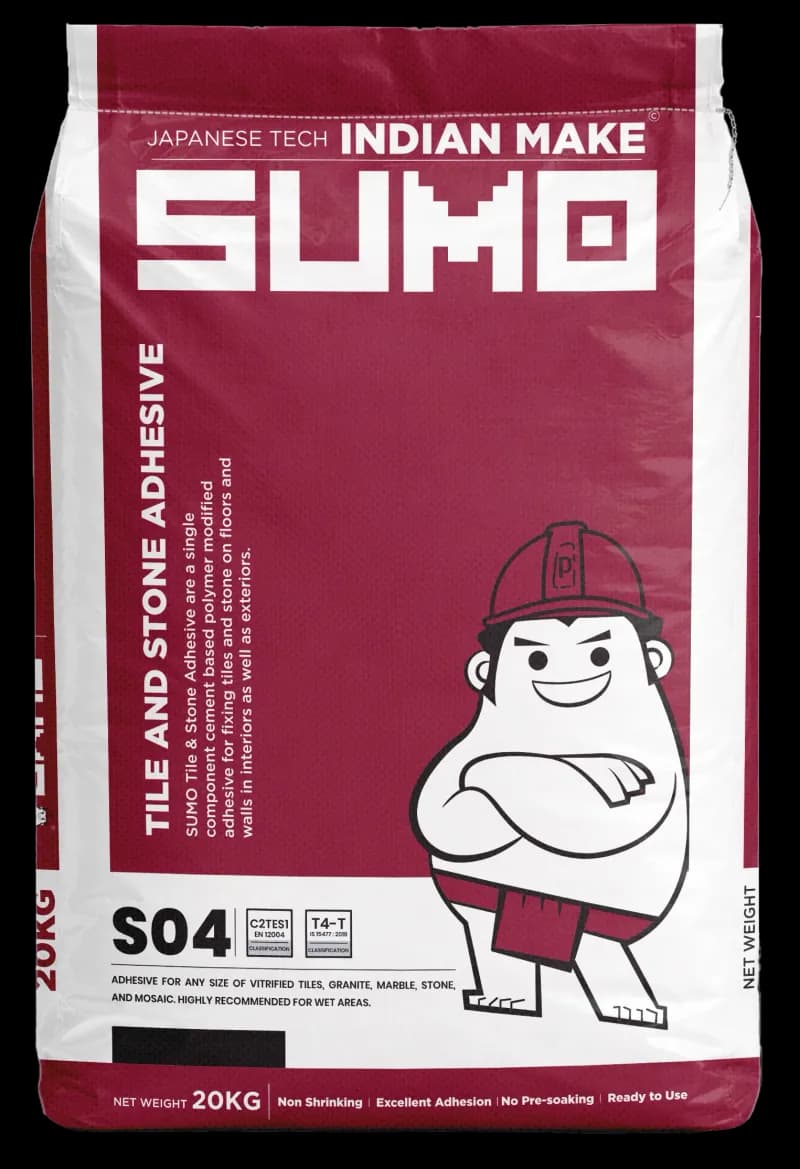
S01 Tile & Stone Adhesive | C1T | T1 | 20 kg bag | 40–50 sq ft @ 3 mm | Internal high-porosity ceramic, terracotta, quarry |
S02 Tile & Stone Adhesive | C2T | T1 | 20 kg bag | 40–50 sq ft @ 3 mm | Improved bond for ceramic & vitrified — including tile-on-tile |
S02 Plus Tile & Stone Adhesive | C2TE | T2 | 20 kg bag | 40–50 sq ft @ 3 mm | Exterior-grade bond for vitrified, natural stone & glass mosaic |
S03 Tile & Stone Adhesive | C2TE | T3 | 20 kg bag | 40–50 sq ft @ 3 mm | Large-format tiles & stone, wet or dry, in or out |
S04 Tile & Stone Adhesive | C2TES1 | T4-TS1 | 20 kg bag | 40–50 sq ft @ 3 mm | Pools, wet areas, heavy-traffic commercial floors |
Flexit 2K Multi-Substrate PU Adhesive | R2T | T5-TS2 | 4 kg bucket | 8–10 sq ft @ 3 mm | Metal, plywood, cement board, engineered stone |
Flexiaddmix (admix with S03) | C2TES2 | T4-TS2 | 1 ltr bottle | 34–40 sq ft @ 3 mm with S03 | Upgrading a bagged adhesive to high deformability |
Two things to notice. First, E appears from S02 Plus upward — that is the extended-open-time class, and in Indian heat it is the difference between a bed that is still bonding when you set the tile and one that has skinned over. Second, deformability starts at S04, which is where you should be for anything on a terrace, a façade, a pool or a young screed.
Coverage, consumption and doing the cost maths properly
A 20 kg bag of SUMO tile adhesive covers 40–50 sq ft at a 3 mm bed. That range is not vagueness — it is the difference between a flat substrate and a wavy one, and between a fresh trowel and a worn one.
Three things quietly destroy coverage on site:
- A worn trowel. Notch teeth round off with use. A 10 mm notch worn to 7 mm delivers roughly a third less adhesive, and you will not see it happening. Replace trowels; they are the cheapest insurance on the job.
- An uneven substrate. Every dip gets filled with adhesive at adhesive prices. Levelling the substrate with a screed or levelling mortar is cheaper than levelling it with adhesive.
- Ridges left un-collapsed. Combed ridges are meant to be flattened by the tile, not left standing as air voids. If lifting a laid tile shows distinct standing ribs, the bed skinned before the tile went down — reduce the area you comb at a time.
For a real cost comparison, work in rupees per square foot installed: (bag price ÷ actual coverage) + labour + wastage. Then compare that against sand + cement + labour + curing time for a thick bed, and add the cost of the tiles you will replace when the hollow ones start lifting.
How many bags of tile adhesive do you need?
Work it from the bed thickness your notch actually delivers, not from the best-case number on the bag. A quick planning table, based on 40–50 sq ft per 20 kg bag at a 3 mm bed:
Area to tile | 3 mm bed (small tiles) | 5–6 mm bed (large format, back-buttered) |
|---|---|---|
100 sq ft | 2–3 bags | 4–5 bags |
500 sq ft | 10–13 bags | 18–22 bags |
1,000 sq ft | 20–25 bags | 36–44 bags |
2,000 sq ft | 40–50 bags | 72–88 bags |
Then add 10% for wastage and round up. Three adjustments to make before you order: a bigger notch pushes consumption up roughly in proportion to the ridge depth; back-buttering adds about 30–50% on top; and an uneven substrate can add more than both combined.
Why tile adhesive fails — and it is rarely the adhesive
In order of how often it actually happens on site:
- Skinned bed / open time exceeded. Adhesive was combed out, the crew got pulled away, and the tile went onto a surface that had already begun to cure. The tile looks fine and is bonded to almost nothing. This is the number-one cause of hollow tiles in Indian conditions.
- Wrong grade for the tile. C1 or slurry under vitrified or large-format tile.
- Poor coverage. Five-blob "dot fixing", no back-buttering under large tiles, ridges left standing.
- Dirty or unsound substrate. Dust, laitance, curing compound, oil, or old paint. Adhesive bonds to what it touches — if that is dust, it bonds to dust.
- Wrong water ratio, or re-tempering. Adding water to a mix that has started to stiffen destroys the polymer network. Mix fresh; never revive.
- No movement joints. Perimeter joints, joints at changes of plane, and field joints in large or external areas. Without them, thermal movement has to be absorbed by the bond line alone.
- Grouting too early, loading too early. The bond needs its cure time before the floor takes traffic or water.
Notice that six of the seven are process, not product. Buying the right grade is necessary; it is not sufficient.
A buying checklist
Before you place the order:
- [ ] Is the EN class printed (C1 / C2, plus T, E, S1, S2)?
- [ ] Is the IS 15477:2019 type printed, with the current BIS licence?
- [ ] Does the grade match your tile porosity and size, not just your budget?
- [ ] Does it carry E if the work is in hot weather, on a terrace, or outdoors?
- [ ] Do you need S1 — terrace, façade, pool, large slab, young screed, heated bed?
- [ ] Is the substrate cementitious, or do you need a resin adhesive?
- [ ] Have you checked shade for glass mosaic or translucent stone?
- [ ] Have you calculated bags from real coverage at your notch size, plus 10% wastage?
- [ ] Is the shelf life intact and the bag stored dry, off the floor?
Tile adhesive glossary
The terms that appear on every technical data sheet, in plain language.
- Adjustment time — the short window after placing a tile during which it can still be tapped into line without breaking the bond.
- Back-buttering — skimming adhesive onto the back of the tile as well as combing the substrate, to guarantee full contact.
- Coverage — area fixed per unit of adhesive at a stated bed thickness. Always tied to a bed thickness; a coverage figure without one is meaningless.
- Deformability (S1 / S2) — how far the cured adhesive can flex before it fails. S1 is 2.5 to 5 mm, S2 is 5 mm and above.
- Laitance — the weak, dusty cement-rich skin on a concrete surface. Adhesive bonded to laitance is bonded to something that is itself loose.
- Open time — how long the combed bed keeps its ability to bond. The single most commonly exceeded parameter on Indian sites.
- Pot life — how long the mixed batch stays workable in the bucket. Longer than open time, and frequently confused with it.
- Reduced slip (T) — the tile does not slide down a vertical surface while the bed is soft.
- Shear adhesion strength — resistance to sliding forces along the bond line. Classified under IS 15477.
- Slaking — the short rest after mixing that lets the polymers hydrate, followed by a brief remix.
- Tensile adhesion strength — force needed to pull a fixed tile straight off the substrate, in N/mm². The headline number of the C1/C2 classification.
- Thin-bed method — fixing in a 3 to 6 mm adhesive bed rather than a thick mortar screed.
- Water absorption — how porous the tile is. Under 0.5% is vitrified/porcelain; above 3% is the porous ceramic that IS 15477 Type 1 addresses.
SUMO is a brand of Adheseal India Company. Grades, pack sizes and coverage figures are from SUMO's current product data; always confirm against the figure printed on the bag or the product page. Standard clause references are to IS 15477:2019 and EN 12004-1:2017 — verify the current QCO status and BIS licence details on the official BIS/DPIIT portals before writing them into a tender.