
How Much Grout Do I Need? The Formula, the Numbers, and What Moves Them
Grout quantity is pure geometry: tile size, joint width, joint depth, density. The formula, real kg-per-m² numbers for Indian tile sizes, and kit-sizing advice.
ON THIS PAGE
- Formula
- kg/m² = ((A+B) ÷ (A×B)) × J × D × density
- SUMOXY epoxy density
- 1.75 kg/L
- SUMOTG cement density
- 1.6 kg/L
- 600×600, 3 mm joint
- ≈ 0.16 kg/m² (epoxy)
- 100×100 mosaic, 3 mm
- ≈ 0.63 kg/m² (epoxy)
- Packs
- SUMOXY 1 kg / 5 kg kits · SUMOTG 1 kg / 5 kg
KEY TAKEAWAYS
- Four numbers decide grout quantity: tile length & width, joint width, joint depth (tile thickness) and grout density.
- On 600 × 600 vitrified at a 3 mm joint, SUMOXY epoxy needs only ≈ 0.16 kg/m² — 1 kg grouts ≈ 68 sq.ft.
- Mosaic is the trap: the same area in 100 × 100 tiles needs about 4× the grout of 600 × 600.
- Consumption scales linearly with joint width — 2 mm → 4 mm doubles the kilograms.
- Buy epoxy in kits sized to what you can place within pot life, not one big kit.
Grout is the last material bought and the most commonly mis-bought — because people estimate it by feel, and joints are pure geometry. The kilograms you need are decided by four numbers, and once you have them, the answer is arithmetic, not judgement.
The four numbers
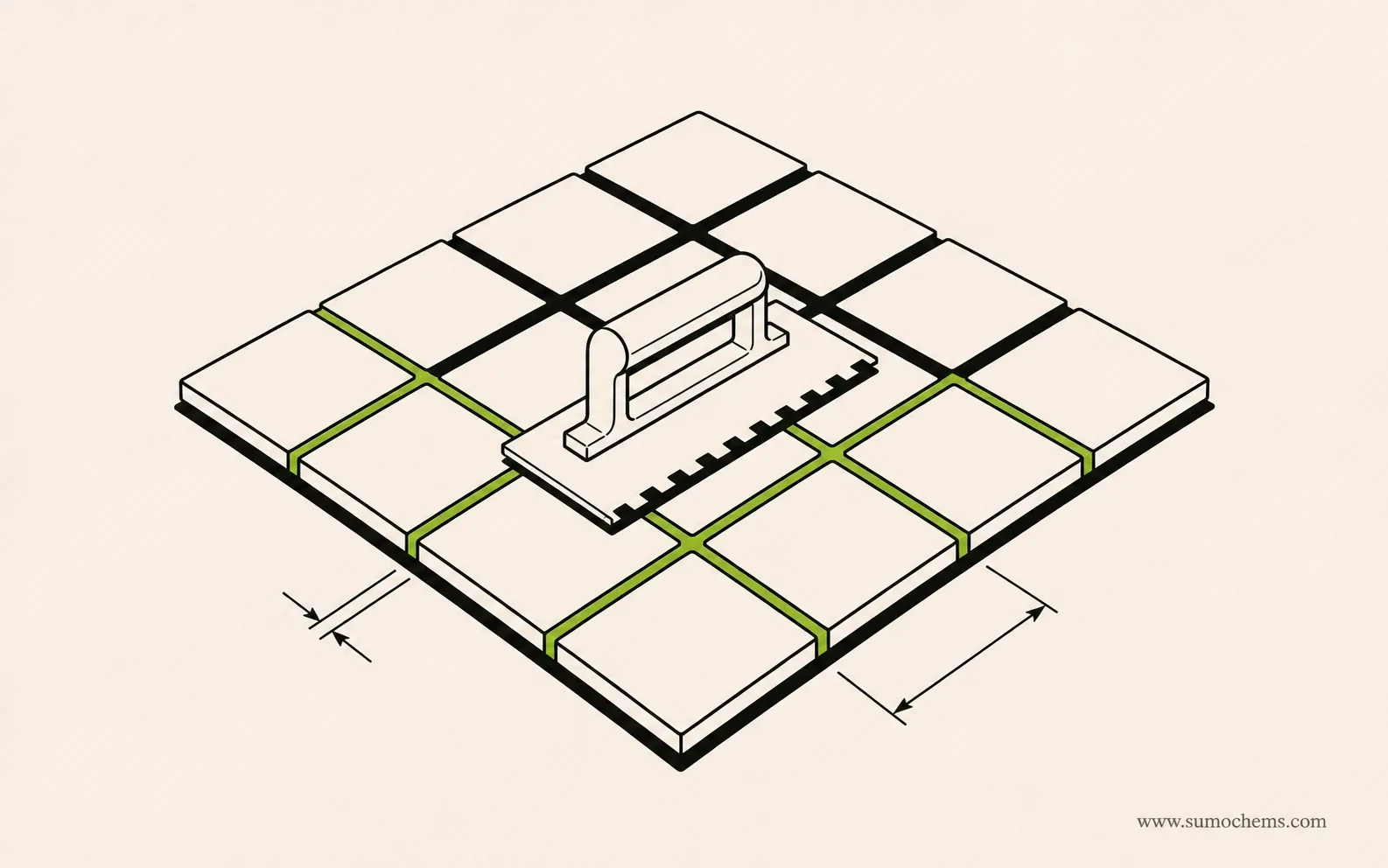
- Tile size (A × B): smaller tiles mean more running metres of joint per m² — this is the dominant factor.
- Joint width (J): 2 mm for rectified vitrified, 3 mm+ for ceramic and stone. Linear effect: half the width, half the grout.
- Joint depth (D): the full thickness of the tile — a 10 mm porcelain takes 25% more than an 8 mm ceramic.
- Density: SUMOXY epoxy 1.75 kg/L; SUMOTG cement grout 1.6 kg/L — cement runs ~9% lighter for the same joints.
The formula
kg per m² = ((A + B) ÷ (A × B)) × J × D × density — with A, B, J and D all in millimetres. The first bracket is simply "how much joint length each square metre contains".
What it produces for common Indian sizes (SUMOXY epoxy, 3 mm joint)
- 100 × 100 mm mosaic (6 mm thick): ≈ 0.63 kg/m²
- 300 × 300 mm (7 mm): ≈ 0.25 kg/m²
- 300 × 600 mm (8 mm): ≈ 0.21 kg/m²
- 600 × 600 mm (9 mm): ≈ 0.16 kg/m²
- 800 × 800 mm (10 mm): ≈ 0.13 kg/m²
- 600 × 1200 mm (9 mm): ≈ 0.12 kg/m²
At a 2 mm joint, take two-thirds of those numbers. For SUMOTG cement grout, multiply by 0.91.
Worked example: a 100 sq.ft bathroom floor
- 100 sq.ft = 9.29 m², tiled in 600 × 600 vitrified, 3 mm joints.
- 9.29 × 0.16 ≈ 1.5 kg of mixed SUMOXY.
- Buy: two 1 kg kits — not one 5 kg kit you will quarter-use.
- Same floor in 100 × 100 mosaic: 9.29 × 0.63 ≈ 5.9 kg — a 5 kg kit plus a 1 kg kit.
Kit sizing beats bulk buying (epoxy only behaves once)
Epoxy grout cures by reaction: once the parts meet, the clock runs regardless of how much is left in the bucket. Plan mixes around the area you can grout and clean inside the pot life on the datasheet. Several 1 kg kits give you fresh mixes across a big floor; an oversized single mix cures in the bucket. Cement grout (SUMOTG) is forgiving here — mix in batches as you go.
Where estimates go wrong
- Ignoring depth: quoting kg/m² without the tile thickness behind it makes any two estimates incomparable.
- Cushion-edged tiles: the bevel opens a wider V at the surface and takes noticeably more than sharp rectified edges.
- Wandering joints: spacers set to 2 mm that drift to 3–4 mm across the room average wider than planned.
- Forgetting walls: wall tiles are thinner but the areas add up — count them separately with their own tile size.
The Grout Calculator under Tools & Support runs this exact formula for every SUMO grout with the tile presets built in — enter your area and joint, get kilograms and kits.