Your tiles started popping off after two monsoons — here's what actually went wrong
Tiles rarely fail on day one — they fatigue loose over two seasons of a moving building. The real cause, and the deformable adhesive that prevents it.

ON THIS PAGE
- Deformable adhesive
- S04 — C2TES1, 1.75 N/mm²
- Deformation
- 2.5 mm (S1)
- Toughest cases
- Flexit 2K PU — T5-TS2, 6 N/mm²
- Movement joints
- Perimeter + every few metres
- Coverage (external)
- ≥95%, solid corners
KEY TAKEAWAYS
- Tiles rarely fail on day one — they fatigue loose over seasons of a moving building.
- Usual causes: a rigid adhesive on a moving surface, no movement joints, laying on green concrete, poor coverage.
- External walls, terraces and large formats need a deformable adhesive (S04) and designed movement joints.
- Full-bed coverage and flexible joints, not spot-fixing and rigid grout.
It's one of the most demoralising things that can happen to a finished building. The tiling looked perfect at handover. Then, a couple of years in — usually after a monsoon or two — a tile lifts. Then another. Some go with a hollow pock underfoot; a few actually tent up and crack. On a façade they start raining down, which stops being a repair bill and becomes a safety problem.
Everyone reaches for the easy explanation — "cheap adhesive." Sometimes true. But far more often the adhesive was ordinary rather than cheap, and the real cause is something nobody accounted for at the time of laying: movement. Here's what's actually happening, and why it takes two seasons to show.
Tiles don't fail on day one. They fatigue.
A tile assembly that's going to fail rarely lets go immediately, because on day one everything is fresh, bonded and unstressed. The failure builds up over cycles.
Every day, the structure moves a little. The sun heats an external wall or a terrace and it expands; at night it cools and contracts. A fresh concrete slab keeps shrinking and drying for months. Buildings settle in their first year or two. None of this is dramatic — it's fractions of a millimetre — but it happens thousands of times.
If the tile, the adhesive and the substrate can't accommodate that movement between them, the stress has to go somewhere, and it goes into the bond. Each cycle nudges the bond a tiny bit. It's fatigue, exactly like bending a wire back and forth until it snaps. Two monsoons — two big cycles of the whole structure wetting, swelling, drying and shrinking — are often what finally tips a marginal bond over the edge. That's why the timing is so consistent.

The specific mistakes that set it up
Almost every "tiles popped off after two years" job traces back to one or more of these:
1. A rigid adhesive on a moving surface. A normal, non-deformable adhesive (C1, or plain cement slurry) sets hard and can't flex. Put it on anything that moves — a façade in the sun, a terrace, a large slab, a fresh screed — and it has no give. The movement goes straight into the bond, and the tile eventually lets go. This is the single biggest cause.
2. No movement joints. A large tiled area is not one rigid sheet. It needs movement (expansion) joints — soft, flexible gaps — at the perimeter, over structural joints, and breaking up big fields, typically every few metres and around every edge. Tile a whole terrace or façade wall-to-wall with grout-hard joints and no movement joints, and the expanding field has nowhere to go but up: tiles tent and pop. Indian sites skip these constantly.
3. Grouting the joints too tight and too hard. Butting tiles together with almost no joint, or filling every joint with rigid grout right up to the movement lines, removes the last bit of give the field had. Tiles need a proper joint width, and the movement joints must be filled with a flexible sealant, not hard grout.
4. Laying on green concrete. Tiling a slab or screed before it has finished its initial shrinkage means the surface is still moving significantly under your fresh bond. It shrinks away underneath the tiles in the following months.
5. Poor coverage / spot-fixing. The old "five blobs of mortar" method (dabbing adhesive at the corners and centre) leaves voids under the tile. Those voids collect water on external and wet areas; water freezes/expands, or just sits and weakens the bond, and the corners — bridging a void — crack and lift. Full-bed coverage isn't optional outdoors.
How to build it so it stays down
- Use a deformable adhesive wherever there's movement. External walls, terraces, balconies, large-format tiles, heated or young screeds — these need an adhesive that can flex with the substrate, not fight it.
- Design in movement joints. Perimeter joints against every wall and upstand, joints over any structural/expansion joint in the building, and intermediate joints breaking large fields into manageable bays. Fill them with a flexible joint sealant, never rigid grout.
- Get full coverage. Comb properly and back-butter big and external tiles for 95%+ contact with solid corners. No blobs.
- Let the substrate cure and dry before tiling, and prime thirsty or difficult surfaces.
- Give tiles a real grout joint and use a flexible grout where the area moves.
The adhesive that would have prevented it
This is exactly the failure the deformable grades exist to stop:
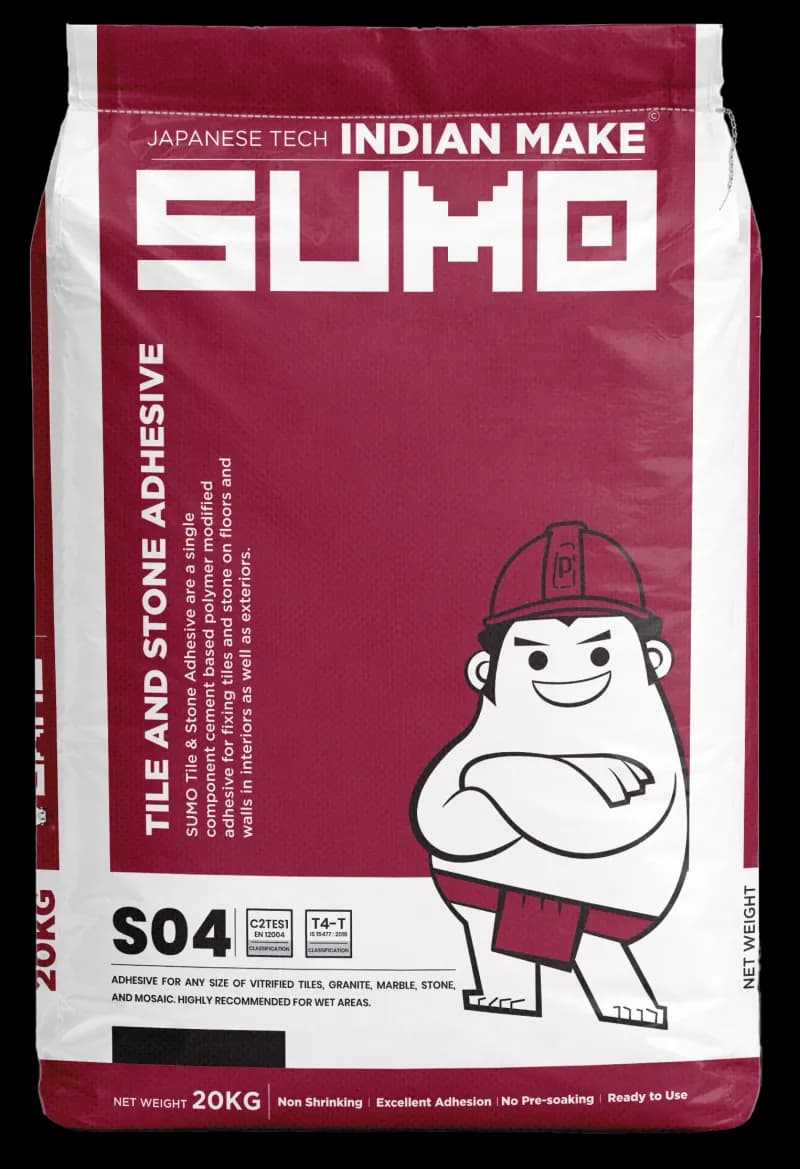
- SUMO S04 (C2TES1 / IS T3-TS1) is the answer for most of these jobs — an improved-bond, extended-open-time, deformable adhesive: tensile adhesion 1.75 N/mm² and transverse deformation to 2.5 mm. That deformability is the whole point — it flexes with the daily thermal movement of a façade or terrace instead of transmitting it into the bond, so the tiles don't fatigue loose. If you're tiling anything external, large-format, or over a slab that will move, this is the grade.
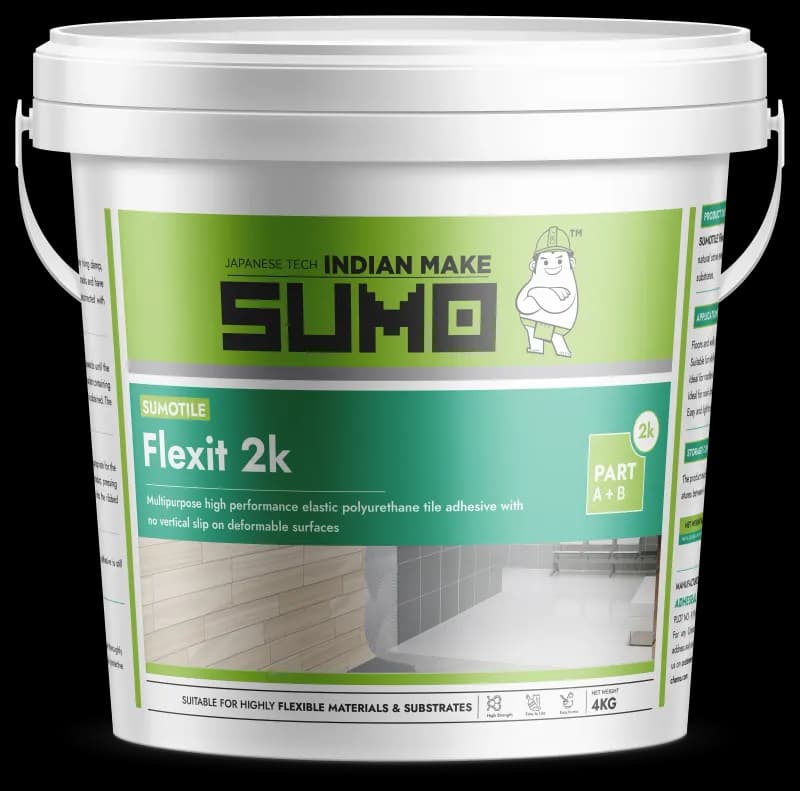
- For the toughest cases — tiling over metal, ply, existing membranes, or badly-moving substrates — SUMO Flexit 2K, a two-part PU adhesive (R2T / IS T5-TS2, the highest deformability class, 6 N/mm² shear), gives you grip and flex that no cementitious adhesive can match.
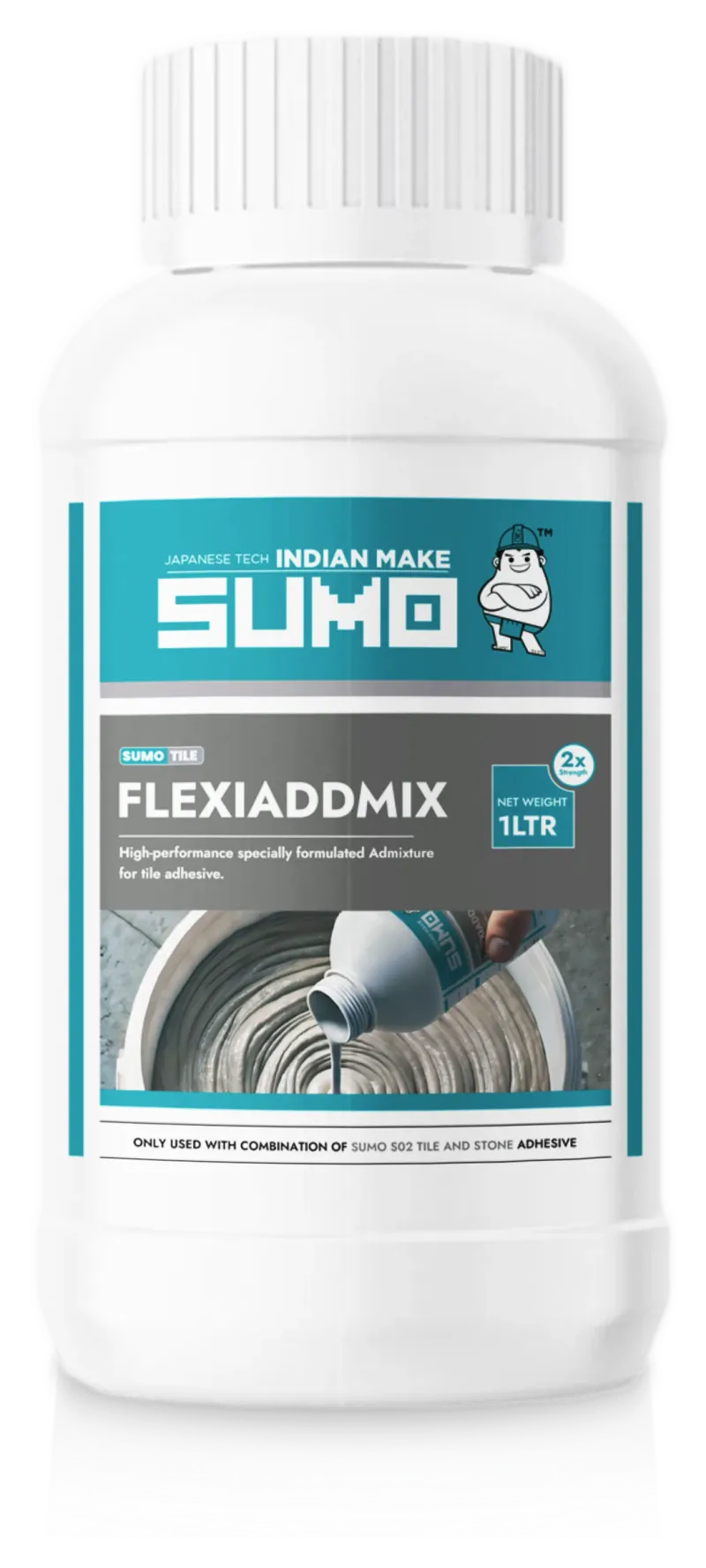
- And if you're building a site mix or want to push an S-grade system higher, SUMO Flexiaddmix with S03 lifts it to a highly-deformable C2TES2 system in a proper, tested ratio.
Tiles popping off after two monsoons isn't bad luck and it usually isn't a bad tile. It's a rigid bond asked to survive a moving building. Give the assembly somewhere to move — a deformable adhesive, real movement joints, full coverage, a cured substrate — and the tiles you lay this year are still down in ten.
SUMO is a brand of Adheseal India Company. Grades and adhesion values are from SUMO's technical data; confirm the current figure on the bag or product page.