Terrace waterproofing that survives an Indian summer, not just the monsoon
Everyone waterproofs a terrace for the rain — then it fails from the heat. Choose the coat for an Indian summer and the monsoon takes care of itself.

ON THIS PAGE
- Terraceguard
- Microfibre-reinforced elastic membrane
- Coverage
- ~20 sq.ft/L per coat (2 coats)
- Terraceguard Cool
- Solar-reflective cool-roof top coat
- Cool coverage
- ~90–100 sq.ft/kg per coat
- VOC
- Low (<50 g/L)
KEY TAKEAWAYS
- Terraces fail from summer heat cycling, not just the monsoon rain.
- Choose an elastic, UV-stable, crack-bridging membrane, not a rigid coat.
- A solar-reflective "cool" finish cuts surface temperature, thermal movement and the room heat below.
- Slope to the outlets, treat parapet and drain details first, two coats, cure and pond-test.
Everybody waterproofs a terrace for the rain. That's the obvious enemy — three months of monsoon and you don't want it in your bedroom ceiling. So the coating gets chosen, quite reasonably, for how well it keeps water out.
And then it fails anyway, usually in year two or three, and everyone blames the rain. But the rain didn't kill it. The other nine months did.
The real load on a terrace isn't water. It's heat.
A terrace in most of India spends the summer as a frying pan. That exposed slab can hit 60–70°C surface temperature on an afternoon in May, then drop 25 degrees or more overnight. Do that every single day for months and the concrete underneath is constantly expanding and contracting — a slow, relentless movement that never stops.
Now think about what that does to a waterproofing coat. A rigid, brittle membrane sitting on a slab that swells and shrinks daily is being flexed thousands of times a season. It doesn't tear in one dramatic moment; it fatigues — goes chalky, hairline-cracks, loses its bond at the edges — until the monsoon arrives and simply walks in through the damage that the summer already did.
So the question to ask a terrace coating isn't only "does it keep water out?" It's "can it stretch and recover, in the sun, every day, for years?"
What actually makes a terrace coating last
Four things, in rough order of how often they get ignored:
1. Elasticity and crack-bridging. The membrane has to be elastomeric — able to stretch well beyond the width of a hairline crack and spring back, so when the slab moves and a crack opens under the coating, the coating stretches over it instead of splitting. This is the property that separates a terrace-grade product from a general waterproofer.
2. UV stability. A terrace membrane is fully exposed to the sun. Many coatings that are perfectly good buried under tiles degrade fast when UV hits them directly — they go brittle and powdery. A terrace coat has to be formulated to hold up to direct sunlight, or it needs to be protected under a screed or tiles.
3. Slope and detailing. Water must run off. A dead-flat terrace ponds, and standing water on any membrane, day after day, is the hardest test there is. Check the falls to the outlets, build up the low spots, and treat the parapet junctions, drain mouths and any pipe penetrations as the high-risk lines they are — coat them first, reinforce them, turn the membrane up the parapet by a good margin.
4. Surface temperature. Here's the summer-specific one. A dark, heat-soaking surface runs hotter, moves more, and pushes that heat straight down into the rooms below — your top-floor bedroom becomes an oven. A reflective, "cool" finish that bounces sunlight back cuts the peak surface temperature substantially. That does two jobs at once: it reduces the daily thermal movement the membrane has to survive, and it keeps the room under it cooler.
The build-up, start to finish
- Prep. Clean, sound slab. Cut out any live cracks and fill them; grind off laitance and loose material; a slightly damp (not wet) surface for cementitious systems.
- Prime where the product calls for it, so the membrane bonds instead of peeling at the edges.
- Treat the details first — parapet junctions, drain outlets, pipe collars — with a reinforcing coat and tape before you do the open field.
- Apply the membrane in two coats, the second at right angles to the first, to full thickness, no pinholes, turned up every vertical face.
- Cure it properly before it takes any traffic or water.
- Protect it if it's a trafficked or heavily-exposed roof — a screed or tiles over the membrane both shields it from UV and takes the foot traffic.
- Pond-test before you sign it off.

What we'd use
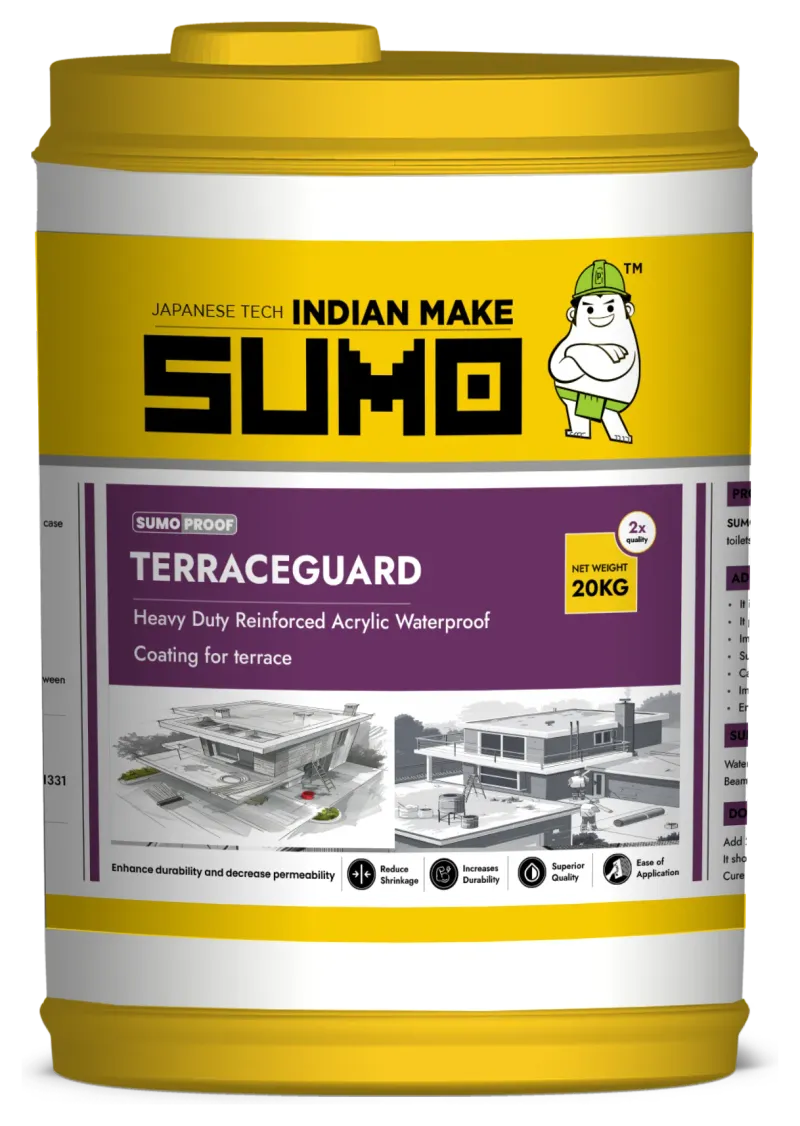
- SUMO TerraceGuard is built as an exposed-terrace waterproofing — a heavy-duty, microfibre-reinforced elastic acrylic membrane, liquid-applied so it cures seamless with no joints or laps to fail on complex terrace shapes. The built-in fibres give it toughness coat after coat, and it's fungus-resistant and low-VOC (<50 g/L). Two coats at about 20 sq.ft per litre per coat, and it flexes with the daily thermal cycling instead of fatiguing. It's the honest workhorse for a roof that takes the weather head-on.
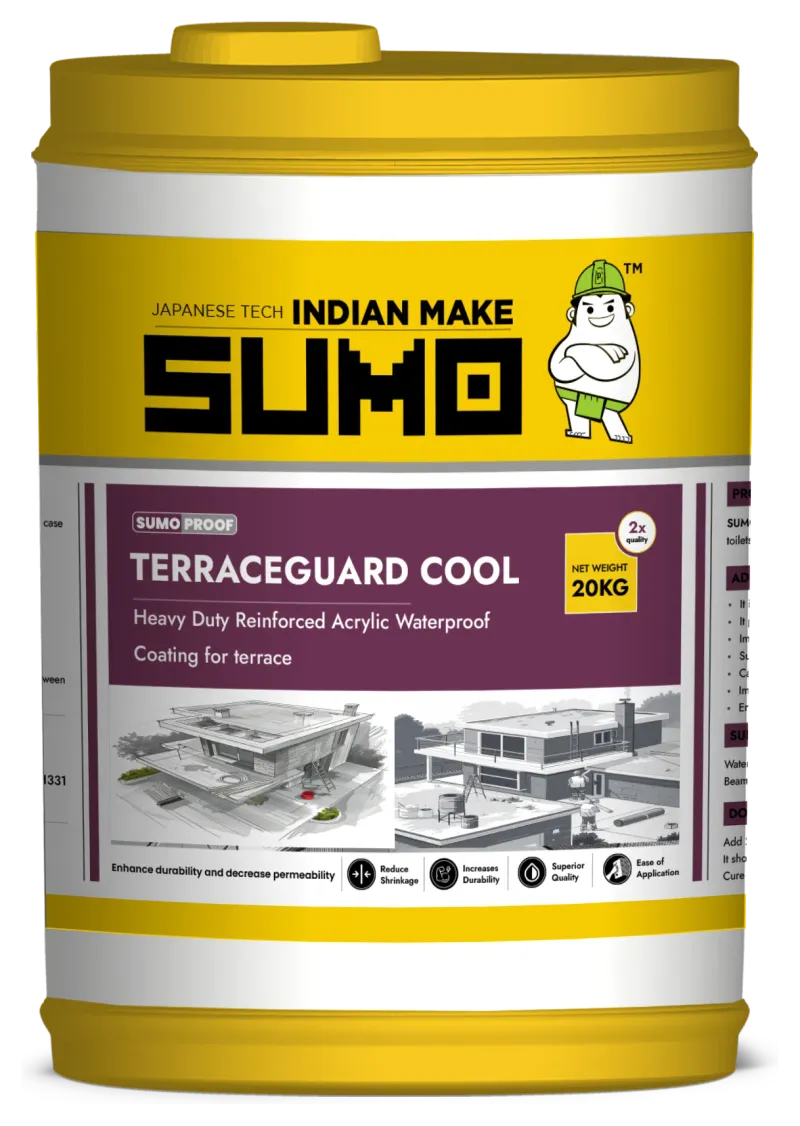
- SUMO TerraceGuard Cool does the same waterproofing job and adds the summer half of the problem: a solar-reflective, low-VOC pure-acrylic "cool roof" finish (roughly 90–100 sq.ft/kg per coat) that bounces sunlight, drops the peak surface temperature, cuts the thermal movement the membrane has to survive, and keeps the top floor measurably cooler. Use it as the reflective top coat over the TerraceGuard membrane, or standalone on a sound, already-waterproof slab. On a south-facing or top-floor terrace, that reflectivity isn't a luxury — it's what makes the waterproofing last and the room livable.
Waterproof a terrace only for the rain and you've solved a quarter of the problem. Choose the coat for the heat — elastic, UV-stable, and reflective where the sun is brutal — and the rain takes care of itself.
SUMO is a brand of Adheseal India Company. Figures above are from the SUMOPROOF TerraceGuard and TerraceGuard Cool technical data sheets (Rev 01); confirm the current values on the pack or product page before quoting.