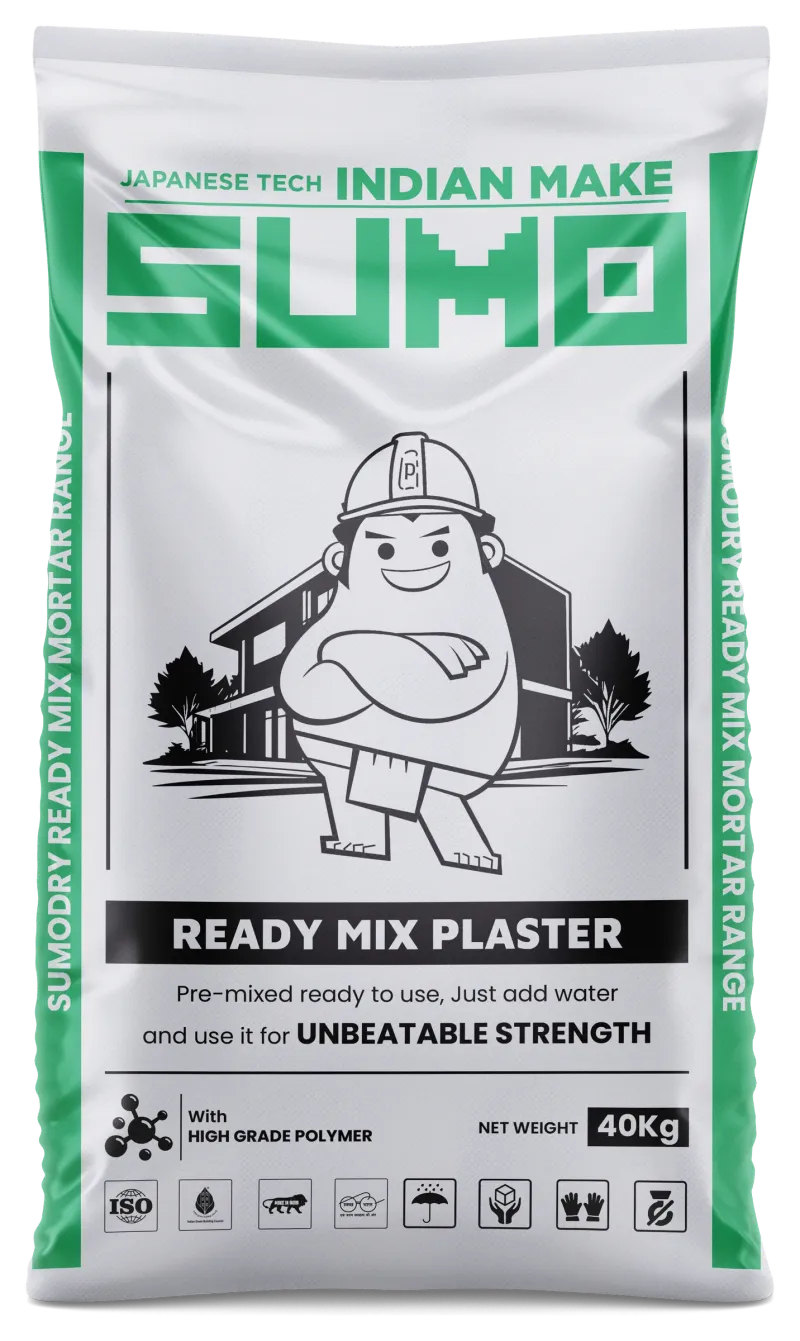
Ready-Mix Plaster Coverage: What One 40 kg Bag Does — and How Site-Mix Compares
One 40 kg bag of ready-mix plaster covers 15–20 sq.ft at 10–12 mm. The consumption maths by thickness, and the honest comparison with site-mixed cement-sand.
ON THIS PAGE
- Consumption
- ≈ 2.2 kg/m² per mm of thickness
- Coverage @ 10 mm
- ≈ 1.8 m² · 20 sq.ft per 40 kg bag
- Coverage @ 12 mm
- ≈ 1.5 m² · 16 sq.ft per bag
- Coverage @ 15 mm
- ≈ 1.2 m² · 13 sq.ft per bag
- Typical thickness
- Internal 10–12 mm · external 15–20 mm
- Pack
- 40 kg bag — just add water
KEY TAKEAWAYS
- Consumption is ≈ 2.2 kg per m² per mm of thickness — everything follows from that one number.
- A 40 kg bag covers ≈ 20 sq.ft at 10 mm, ≈ 16 sq.ft at 12 mm, ≈ 13 sq.ft at 15 mm.
- Thickness is the entire cost driver: going 12 → 15 mm is +25% material on the same wall.
- Site-mix comparisons must count sand losses, ratio drift and the 1.35 dry-volume factor — not just cement bags.
- Check wall plumb before quoting thickness; a leaning wall doubles the bags quietly.
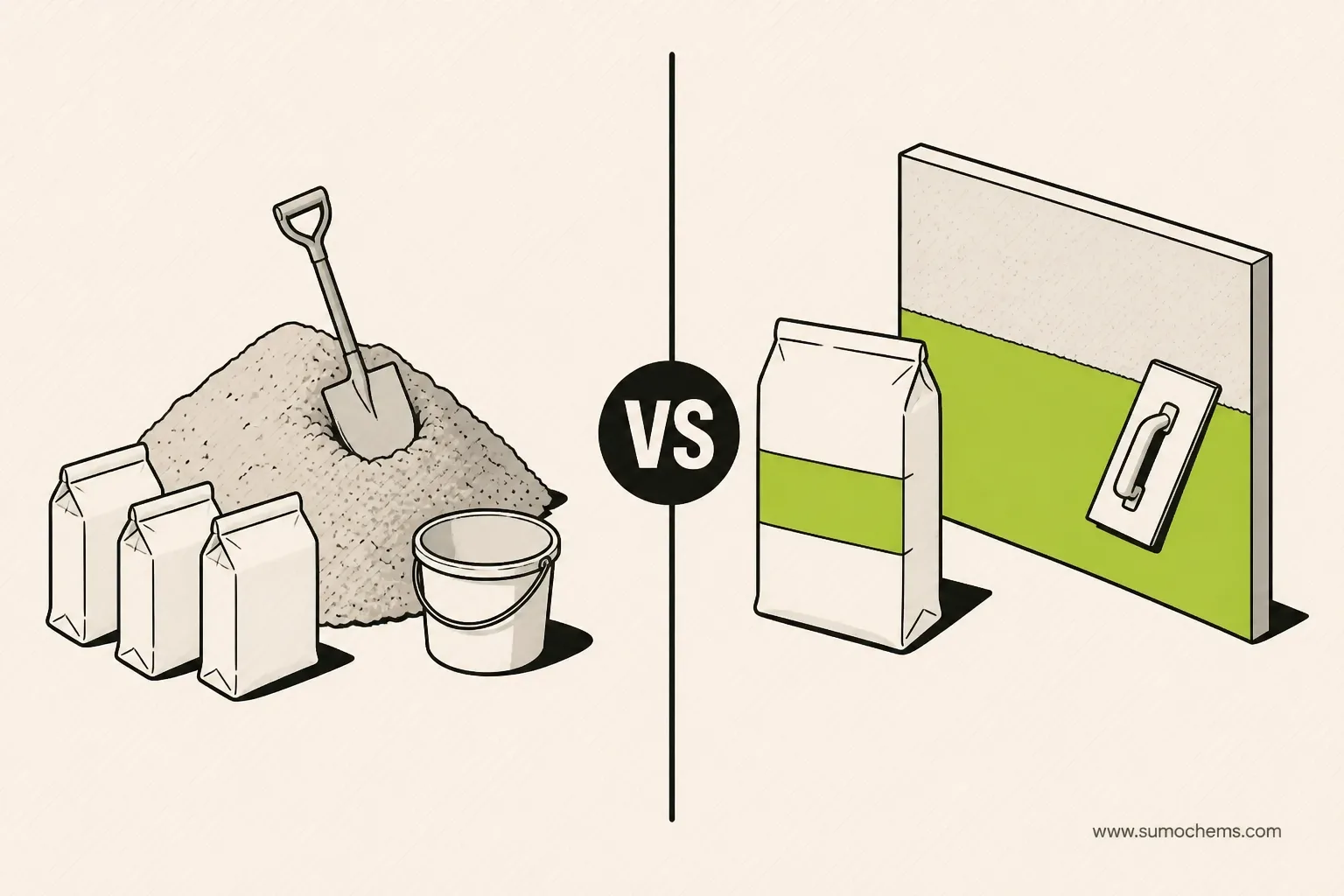
Search for "plaster calculator" and every result assumes you are batching cement and sand on site — ratios, dry-volume factors, sand in brass. Ready-mix plaster removes all of that: the wall needs a known number of kilograms, and kilograms come in 40 kg bags. This guide gives the coverage maths, then compares it honestly with site-mix.
The one number that matters
SUMO Ready-Mix Plaster consumes about 2.2 kg per m² for every millimetre of thickness — calibrated to the brochure coverage of 15–20 sq.ft per bag at the standard 10–12 mm internal coat. From that:
- 10 mm internal coat: 22 kg/m² → a bag does ≈ 1.8 m² (20 sq.ft)
- 12 mm standard internal: 26 kg/m² → ≈ 1.5 m² (16 sq.ft)
- 15 mm external: 33 kg/m² → ≈ 1.2 m² (13 sq.ft)
- 20 mm external/uneven, in two coats: 44 kg/m² → ≈ 0.9 m² (10 sq.ft)
Worked example: one 400 sq.ft room at 12 mm
- 400 sq.ft of wall = 37.2 m².
- 37.2 × 26.4 kg ≈ 981 kg → +10% wastage ≈ 1,079 kg.
- 1,079 ÷ 40 = 27 bags.
The honest site-mix comparison
A fair comparison is not "bag price vs sand price". Site-mix carries costs that never appear on an invoice:
- The dry-volume factor: mixed mortar shrinks ~35% from its dry ingredients, so every m³ of plaster needs ~1.35 m³ of materials — most site estimates forget it and under-order.
- Sand losses: stored loose in the open, 10–20% of a heap is walked away, blown away or rained into the ground.
- Ratio drift: hand batching swings between 1:4 and 1:6 across a day — the weak batches crack, and rework is the most expensive plaster there is.
- Screening and supervision: site sand needs sieving and someone watching the ratios; a factory-blended bag needs neither.
Ready-mix trades all of that for a predictable count of identical bags — which is exactly why its coverage can be quoted per bag while site-mix coverage is always "it depends".
Thickness discipline: where the money goes
Every millimetre is 2.2 kg/m² across the whole wall. Before quoting bags, check the walls for plumb — masonry leaning 10 mm needs a 20 mm average coat to come true, doubling the estimate. On AAC blockwork, dimensional accuracy usually lets you plaster at the thin end of the range: block walls built with thin-bed jointing routinely take 10–12 mm where brickwork needs 15–20. The plaster savings are part of the AAC system economics.
The Plaster Calculator under Tools & Support runs area × thickness × 2.2 with wastage built in — enter the wall, get bags.